Comparison guide
Managed agent platform for Claude and Codex: Type.com
Why teams run both, what a managed platform should handle, and how six options compare as of November 10, 2026.
By Type.com Team
Which managed agent platform runs both Claude and Codex agents?
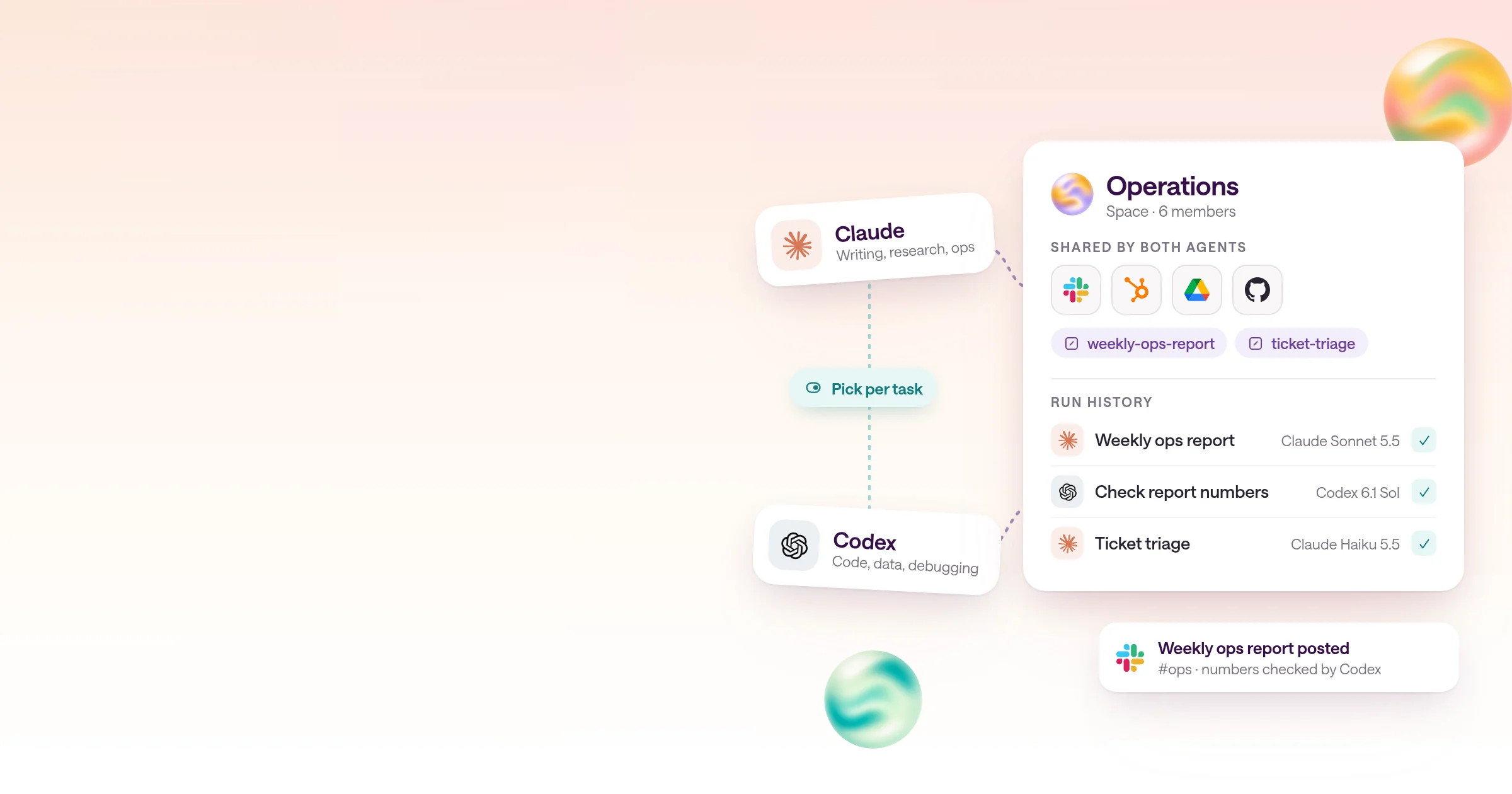
Type.com is a managed agent platform that runs both Claude and Codex agents in one workspace, so your team can pick the model per task and share the same tools, skills and run history.
Each team works in a Space, which holds its connections, skills, memory, threads, and automations. A Space starts with Claude or Codex as its default, and you can switch a thread or an automation to the other one. Type.com runs the agent in the cloud, keeps credentials out of automation code, and records every run as a thread the team can read.
It's built for whole teams, not only engineers. People describe an automation in plain words, run it on a schedule or from Slack, and connect the Claude or ChatGPT subscriptions they already pay for. Plans are priced by team size, from $50 a month for 2 team members, and every plan starts with a 14-day free trial.
- Agents: Claude and Codex in every Space, chosen per thread, automation, or automation step.
- Price for 30 people: $500 a month for up to 40 team members, with $1,000 of AI usage included.
- Triggers: schedules, Slack, GitHub, Linear, webhooks, email, and RSS, with runs in the cloud.
- Access: public or private Spaces, Full or Read-only connections, and admin analytics.
Why do teams run both Claude and Codex?
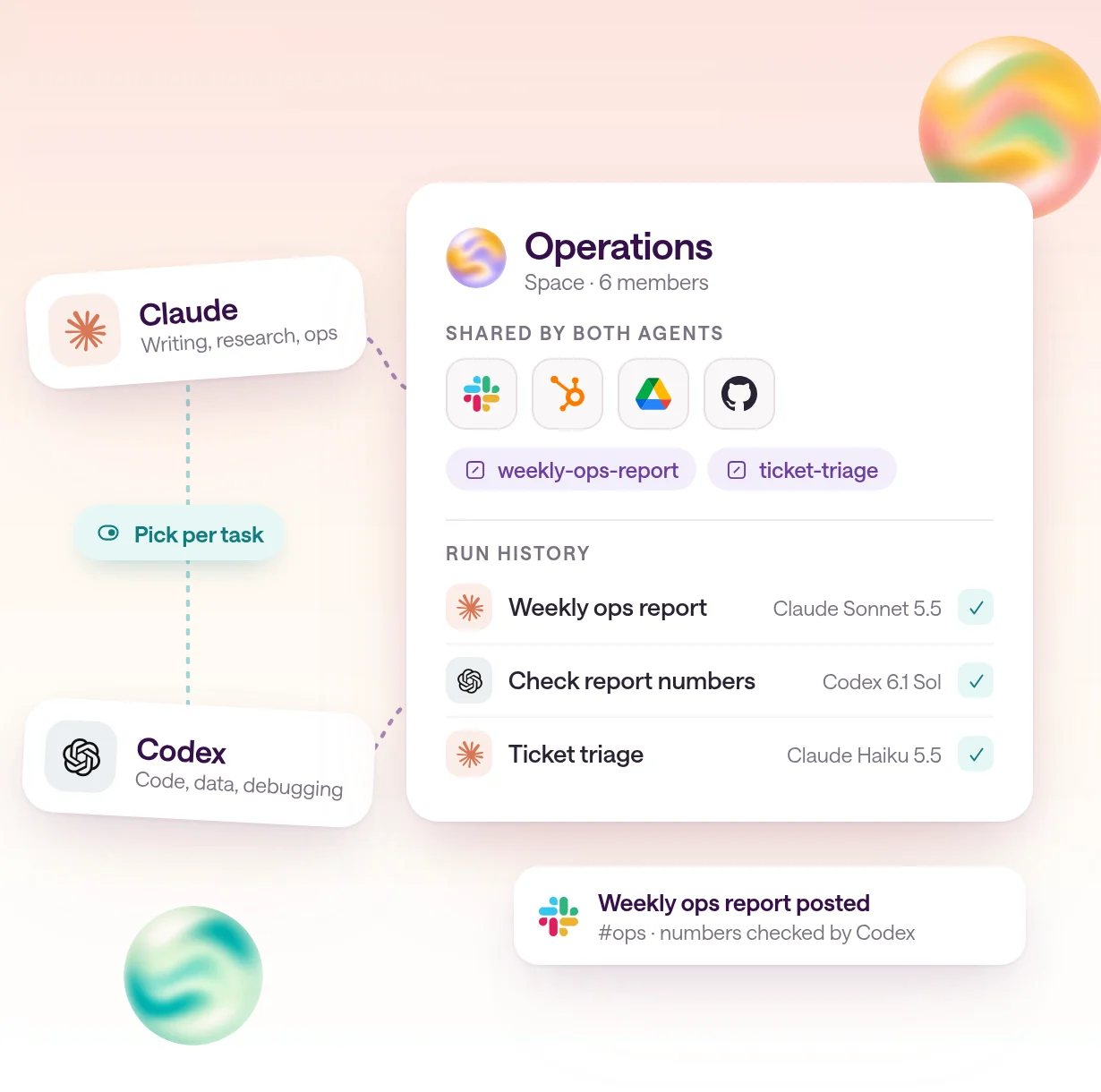
Teams run both because each fits different work, the model is the biggest lever on cost, and a second provider keeps work moving when the first one has problems.
Task fit comes first. Type.com's model guide suggests starting with Codex for code-heavy work, repository changes, and technical investigation, and with Claude for research, analysis, writing, and operational work. Those are defaults, not limits: a support lead may prefer Claude for customer replies while the data person uses Codex to debug a broken sync.
Cost follows the model. Type.com meters AI usage at each provider's published API rates, so a flagship model costs more per token than a faster one, and its billing docs call model choice the biggest lever on cost. Teams put routine, high-volume work on a smaller model and save the flagship for work that needs it. People who already pay for Claude or ChatGPT can connect those subscriptions, so their eligible requests don't use the workspace's credits.
Every provider has outages and usage limits. When Claude or Codex is slow or unavailable, you can move the work: pick the other agent for a thread, change an automation's model, or change a Space's default. The Space's connections, skills, and memory stay the same, so nothing has to be rebuilt.
What does “managed” mean for an agent platform?
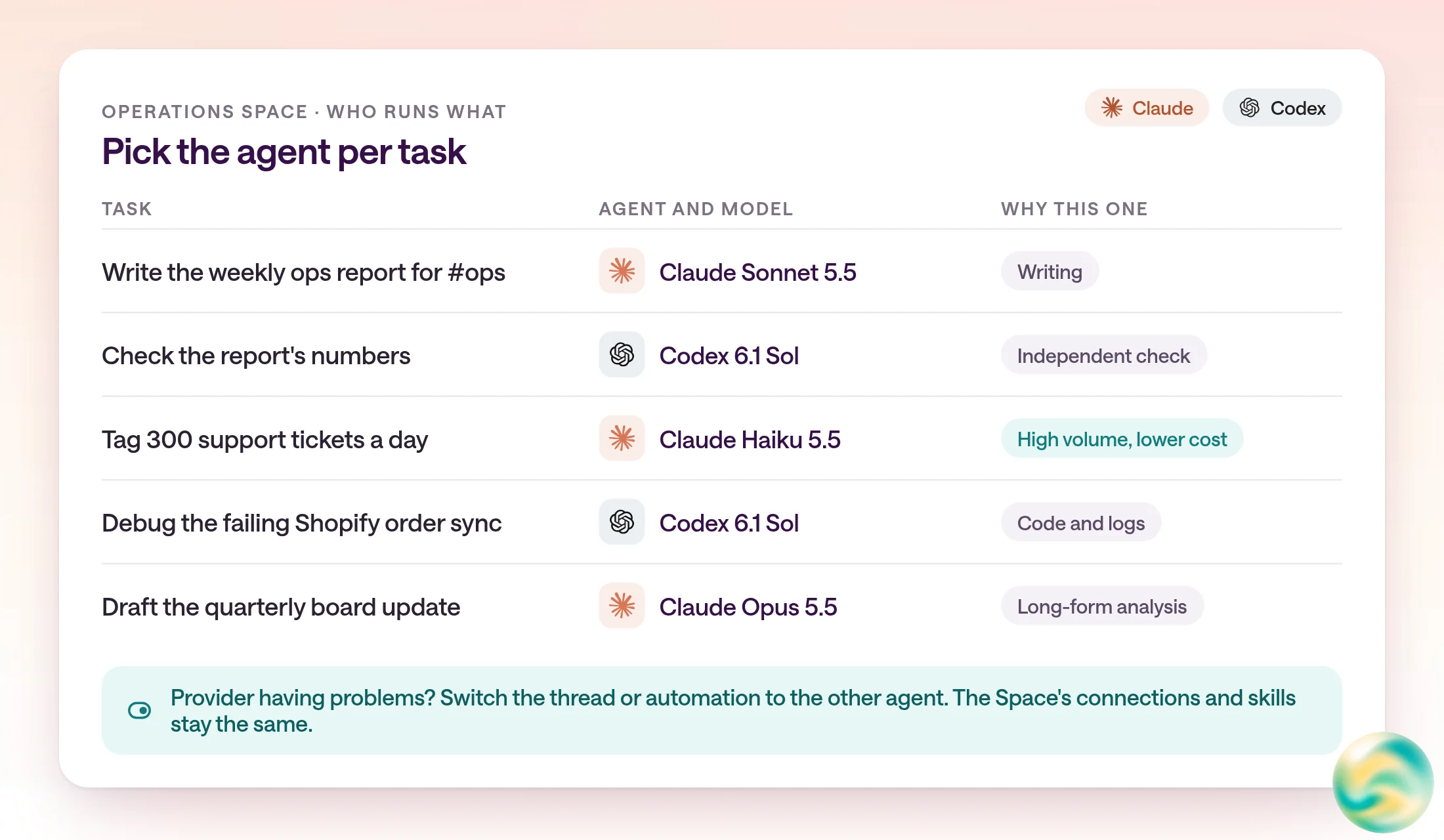
A managed agent platform runs the agent for you: a cloud runtime, credentials the agent's code never holds, a log of every run, and permissions on who can reach which tools.
Cloud runtime. Runs start without anyone's laptop: from a schedule, a Slack message, a GitHub or Linear event, a webhook, an email, or an RSS item. Type.com keeps the schedules and receives the events, and each automation gets an isolated Linux sandbox for shell commands, Git, and scripts.
Credentials. Connections are added once, through OAuth, API keys, service accounts, or hosted MCP servers, and shared with the Spaces that need them at Full or Read-only access. Type.com stores the credentials, and code automation runs get a short-lived token instead of a provider credential.
Run logs. Each run makes a thread with the agent's messages and tool calls, and run history records the output and any errors. Admins see each Space's automations, with their owners, status, failures, and AI cost, in Settings → Analytics.
Permissions. Spaces are the access boundary: a private Space is limited to the people who were added, and a run acts with the access of the person who started it. Scheduled runs act as the automation's creator, so a shared Team connection keeps the work from depending on one person's login.
How do Claude Managed Agents, Codex cloud, AgentCore, xpander.ai, and Type.com compare?
Checked against each vendor's documentation on November 10, 2026: Type.com and xpander.ai run both Claude and Codex agents, Claude Managed Agents runs Claude, Codex cloud runs Codex, AgentCore runs the agents you build on AWS, and running the two SDKs yourself leaves the platform work to your engineers.
Claude Managed Agents is Anthropic's harness and infrastructure for running Claude as an agent, in beta on the Claude API. Your application creates agents and sessions and sends them events, and scheduled deployments can start runs on a cron schedule. Each session runs in an Anthropic-managed cloud sandbox or one you host. Pricing is Claude tokens plus $0.08 per session-hour while a session is running, per Anthropic's pricing.
Codex cloud runs Codex coding tasks in cloud environments set up with your repositories, dependencies, network rules, and secrets. People start tasks from ChatGPT on the web, mobile, or desktop, or from the Codex CLI, and with cloud delegation turned on, by mentioning @ChatGPT in Slack. They review the changes and open pull requests. It's included with ChatGPT Plus, Pro, Business, and Enterprise plans, per OpenAI's Codex pricing.
Amazon Bedrock AgentCore is AWS's platform for building, deploying, and operating agents with any framework and foundation model, including Claude and OpenAI models. Developers deploy their own agent code to Runtime, which isolates each session in a microVM, or declare an agent in configuration and let the managed harness run the loop. Runtime v1 costs $0.0895 per vCPU-hour and $0.00945 per GB-hour, plus model usage, per AgentCore pricing.
xpander.ai calls itself an AI workspace and secure agent runtime for a whole company. Its agents run on Claude Code, Codex, or OpenCode in an isolated sandbox, reach their models through xpander's gateway with budgets, and take work from Slack, Microsoft Teams, email, schedules, webhooks, or the API. It runs in xpander's cloud, your VPC, your data center, or air-gapped. Pricing is usage-based credits with unlimited seats, and enterprise licenses start at 50 agents, per xpander.ai pricing.
Running both yourself means hosting the Claude Agent SDK and the Codex SDK on your own servers. Anthropic suggests 1 GiB of RAM, 5 GiB of disk, and 1 CPU per agent as a starting point and estimates a minimal container at roughly $0.05 an hour before tokens. The schedules, credentials, logs, permissions, and the interface your team uses are yours to build. Our guide to hosting the Claude Agent SDK covers that work.
| Option | Agents it runs | What it runs for you | What your team does | Pricing |
|---|---|---|---|---|
| Type.com | Claude and Codex, chosen per Space, thread, automation, or agent stage | Cloud runs on schedules, Slack, GitHub, Linear, webhooks, email, and RSS; a sandbox per automation; stored credentials; a thread for every run | Describes the work in plain words or code and picks the models | $50 to $750 a month for 2 to 60 team members, AI usage included at provider rates; 14-day free trial |
| Claude Managed Agents | Claude | The agent loop, a cloud sandbox per session (or one you host), event history, and cron schedules | Builds the application that starts sessions, runs custom tools, and shows results | Claude tokens plus $0.08 per session-hour while running; in beta |
| OpenAI Codex cloud | Codex, on OpenAI models | A cloud environment per task with your repositories, setup, network access, and secrets | Starts coding tasks from ChatGPT, the CLI, or Slack, and reviews the changes | Included with ChatGPT Plus ($20 a month), Pro (from $100), Business ($20 per user a month billed annually), and Enterprise |
| Amazon Bedrock AgentCore | Agents you build with any framework or model, including Claude and OpenAI models | A serverless runtime with a microVM per session, plus gateway, identity, memory, and observability on AWS | Writes or configures the agent, sets up triggers and tools, and builds the interface | Runtime v1 at $0.0895 per vCPU-hour plus $0.00945 per GB-hour, plus models |
| xpander.ai | Claude Code, Codex, or OpenCode harnesses, on any model | Agent runtime in an isolated sandbox, an AI gateway with budgets, and work from Slack, Teams, email, schedules, and webhooks | Sets up agents, skills, models, budgets, and policies, in xpander's cloud or your own infrastructure | Usage-based credits with unlimited seats; enterprise license from 50 agents |
| Run them yourself | Claude Agent SDK and Codex SDK on your own servers | Nothing; your engineers host and operate it | Hosts containers and builds schedules, credentials, logs, permissions, and the interface | Your compute (about $0.05 an hour for a minimal container, per Anthropic) plus model usage |
Which option fits your team?
Choose by who will use the agents: your product's users, your engineers, your platform team, IT, or the whole company.
For a 20 to 200 person company rolling AI out beyond engineering, the deciding question is usually who maintains the setup. If nobody should have to build an application, host containers, or manage a gateway before the first useful run, start with a platform where triggers, connections, and an interface for the team come built in.
For more options, see Claude Managed Agents alternatives and Type.com vs Amazon Bedrock AgentCore.
- Claude Managed Agents: you're building Claude into your own product and want Anthropic to run the agent loop.
- Codex cloud: your engineers want to hand coding tasks to Codex from ChatGPT or Slack.
- Amazon Bedrock AgentCore: your platform team builds agents inside AWS with its own framework and models.
- xpander.ai: IT wants a governed runtime for coding agents behind one gateway, including in its own VPC or air-gapped.
- Running it yourself: you need full control and have engineers to host and operate it.
- Type.com: your team wants Claude and Codex working on shared connections and skills, with automations anyone can describe in plain words.
How does switching models per task work on Type.com?
Set a default for each Space, override it for a thread or an automation, and give a code automation's agent stages their own models. The Space's connections, skills, and memory stay the same whichever model runs.
There are four places to choose a model, from the broadest to the narrowest. Each one takes a few clicks, and none of them changes the Space's connections or skills.
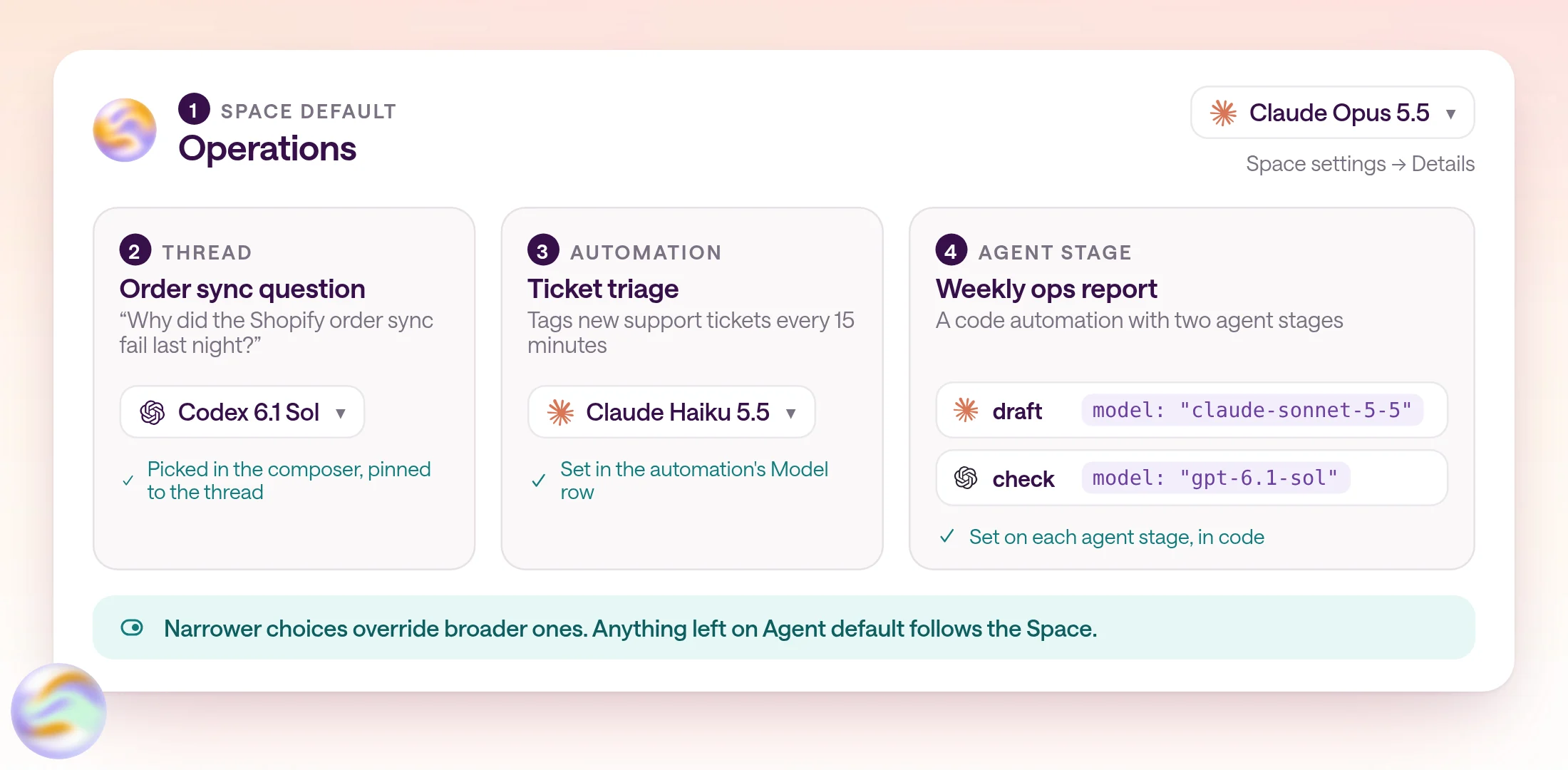
- 1
Set each Space's default
In Space settings → Details, choose Claude or Codex, then the model, reasoning effort, and Fast setting. New threads and automations that use Agent default inherit it.
- 2
Switch one thread
In the composer, choose Claude or Codex and a model before you send. The choice is pinned to that thread, so replies in it keep running on that model.
- 3
Pin a model to an automation
In the automation's Model row, keep Agent default or choose a specific model, reasoning effort, and speed. Every run of that automation uses it.
- 4
Give one step its own model
In a code automation, set model on an agent stage, for example a Claude model to draft and a Codex model to check the draft. Stages without one use the automation's model.
- 5
Connect both subscriptions
Each person can connect a Claude and a ChatGPT subscription in Settings → Details → Use your own coding subscriptions. Eligible requests run through them, and automations use their creator's.
How does one automation use Claude and Codex together?
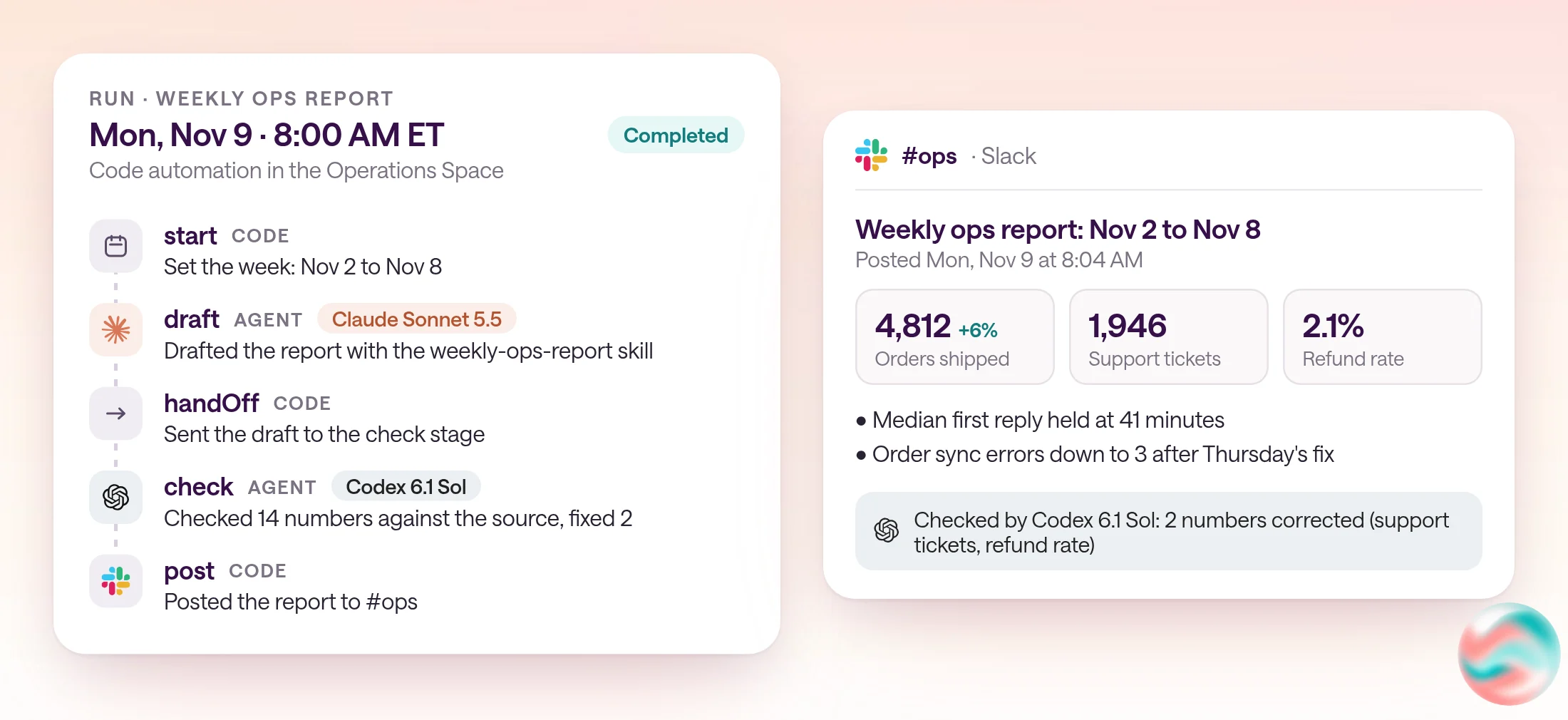
In a Type.com code automation, each agent stage can name its own model, so Claude can draft and Codex can check the same run's work before code posts the result.
Type.com's deployment reference describes the agent stage's model setting for exactly this: a cheaper model for a routine check, or a model from the other provider as an independent reviewer. Any model that Claude or Codex agents in Type.com can run is allowed, and a stage without one uses the automation's model.
Here the Operations team's weekly report runs on Claude Sonnet 5.5, and a second agent stage on Codex 6.1 Sol checks every number against the source data before a code stage posts to #ops. Both stages act as the automation's creator and use the same Space connections and skills.
draft: agent({
  input: week,
  output: report,
  model: "claude-sonnet-5-5",
  instructions:
    "Write this week's ops report with the weekly-ops-report skill.",
  onResult: "handOff",
}),
handOff: code({
  input: agentResult({ input: week, output: report }),
  transitions: ["check"],
  run: ({ input }) => next("check", input.result),
}),
check: agent({
  input: report,
  output: report,
  model: "gpt-6.1-sol",
  instructions:
    "Check each number against the source data. Fix any that are wrong.",
  onResult: "post",
}),
What does Type.com cost for a 30-person team?
$500 a month. A team of 30 is on the $500 Enterprise plan, which covers up to 40 team members and includes $1,000 of AI usage a month, and every plan starts with a 14-day free trial.
Type.com prices by workspace and team size, not by seat, and every plan includes every feature. Usage for both Claude and Codex comes out of one monthly allowance, metered at each provider's published API rates, according to Type.com pricing and the billing docs, checked November 10, 2026.
Requests that run through a person's connected Claude or ChatGPT subscription don't use the allowance. Admins get a heads-up at about 80% of it, then choose whether to move up a plan, add credits, or wait for the next month, so there are no surprise overages. Teams of more than 60 people use a custom contract.
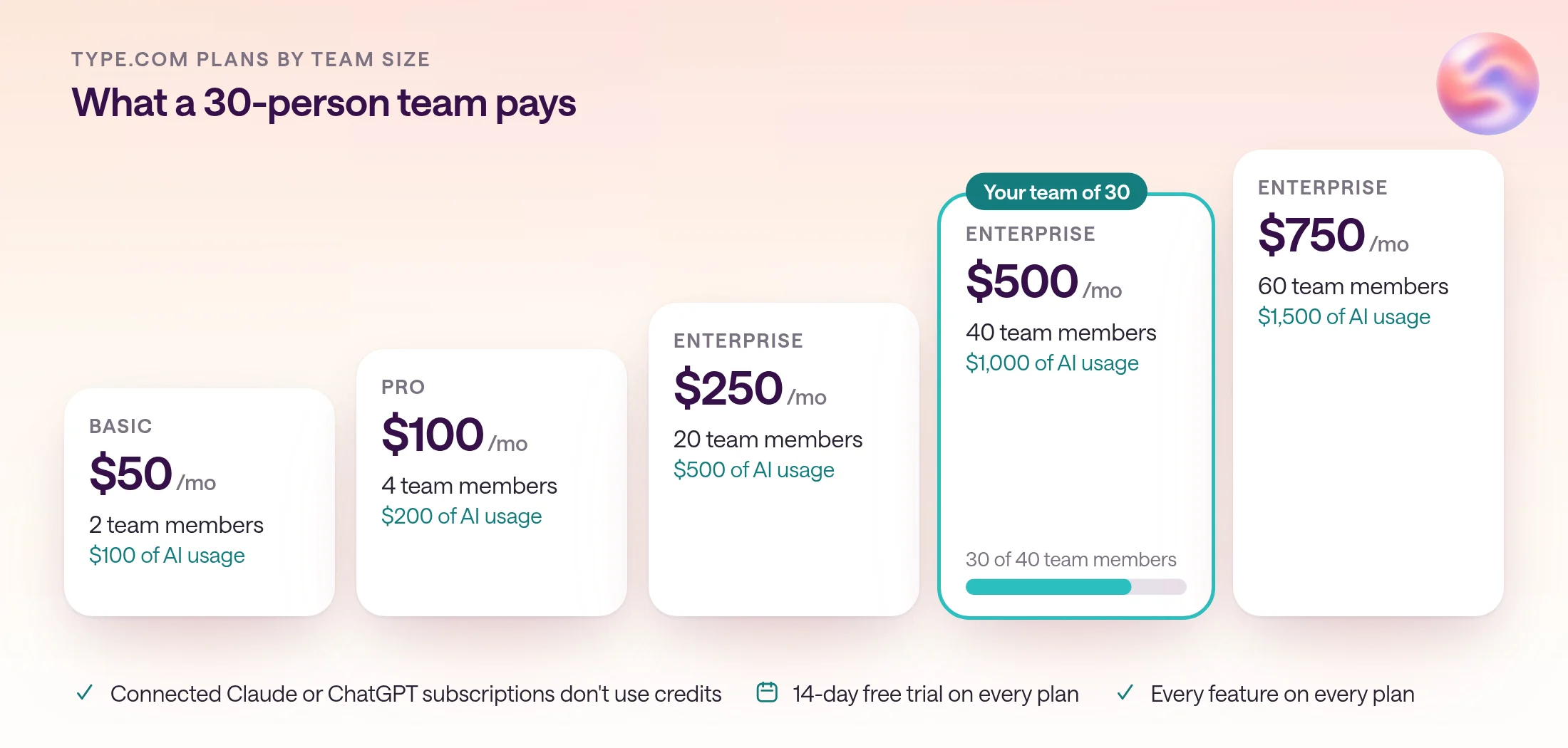
| Team members | Plan | Price a month | AI usage included a month |
|---|---|---|---|
| Up to 2 | Basic | $50 | $100 |
| Up to 4 | Pro | $100 | $200 |
| Up to 20 | Enterprise | $250 | $500 |
| Up to 40 | Enterprise | $500 | $1,000 |
| Up to 60 | Enterprise | $750 | $1,500 |
Can a non-technical team use it, in Slack and on a schedule?
Yes. People describe automations in plain words, run them on a schedule or from Slack, and admins decide who can reach which tools.
An instruction automation is what you want done, in plain words. Ask Type.com in a Space to create one, or start a Space from a template for Engineering, Marketing, Support, Sales, Data, or HR & Ops and approve the skills, automations, and connections it proposes.
Schedules run weekly, monthly, or at an interval in the time zone you choose, and Slack can start a run when someone mentions the Type.com app in a selected channel. Automations made from a template start paused, and a private Test run shows the result before anything posts to the team.
For a security review, Type.com holds a CASA Tier 2 certification from the App Defense Alliance, valid until May 2027, has completed an independent third-party penetration test, and publishes its controls and subprocessors on its trust center. Admins set each person as a member or an admin and see every Space's automations, owners, and AI cost in one dashboard.
Frequently asked questions
Can one automation use Claude for one step and Codex for another?
Yes. In a Type.com code automation, each agent stage can set its own model, so one stage can run on Claude and another on Codex, for example Claude Sonnet 5.5 to draft a report and Codex 6.1 Sol to check its numbers. Stages without their own model use the automation's model. An instruction automation runs on the model set in its Model row.
Do I bring my own API keys or subscriptions?
Neither is required. Every Type.com plan includes AI usage for Claude and Codex models, metered at the provider's published rates, so there are no model API keys to set up. If you already pay for Claude or ChatGPT, connect that subscription in Settings, and eligible requests run through it instead of the workspace's credits. Automations use the subscription of the person who created them.
How is Type.com billed?
By workspace, based on team size. Basic is $50 a month for 2 team members, Pro is $100 for 4, and Enterprise is $250 for 20, $500 for 40, or $750 for 60. Each plan includes AI usage worth twice its price, metered at the provider's rates, and every plan starts with a 14-day free trial. Teams of more than 60 people use a custom contract.
Do I need both a Claude and a ChatGPT subscription to use both agents?
No. Claude and Codex requests run on the workspace's included AI usage when nobody has connected a subscription. Connecting one is optional: it lets eligible requests run through a plan you already pay for, so they don't use the workspace's credits.
Does Type.com work in Slack and on a schedule?
Yes. Automations run on weekly, monthly, or interval schedules in the time zone you choose, and Slack can start a run when someone mentions the Type.com app in a selected channel. A Slack channel connected to a Space brings its messages into the Space, and the agent can reply in Slack.
How is Type.com different from Claude Managed Agents or Codex cloud?
Claude Managed Agents is an API for running Claude inside an application you build, and Codex cloud runs Codex coding tasks for people working in ChatGPT. Type.com runs both Claude and Codex for a team's own work, with triggers, shared connections and skills, and a thread for every run built in.