
Alternatives guide
Claude Managed Agents alternatives: 8 options in 2026
Eight managed agent platforms compared on what you build, which models run, what starts a run, and what it costs.
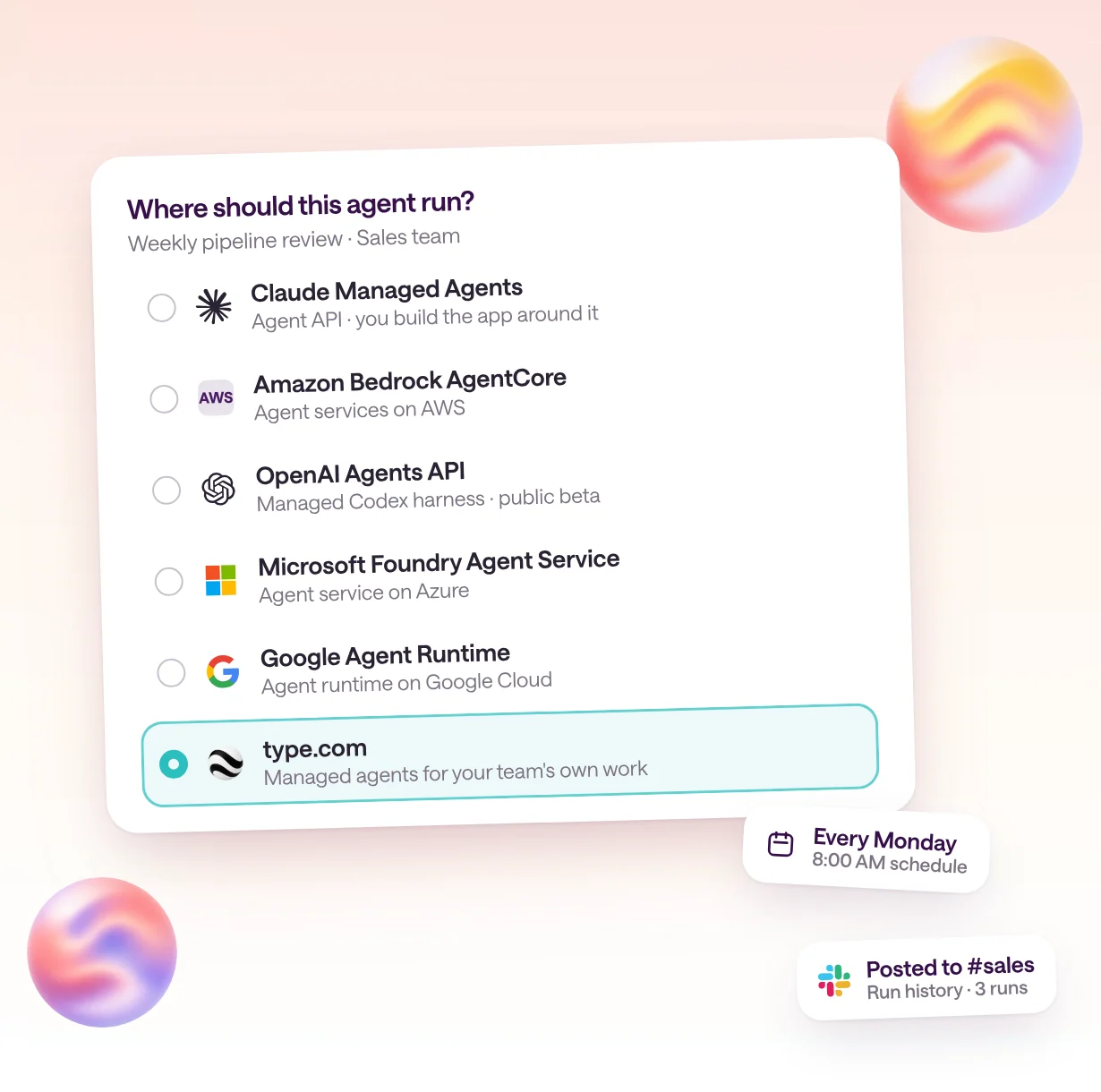
What is Claude Managed Agents, and why look for alternatives?
Claude Managed Agents is Anthropic's hosted runtime for Claude agents, in public beta on the Claude Platform. Your application creates agents and sessions through the Claude API, and Anthropic runs the agent loop and a Linux container for each session. Teams compare alternatives when they need other models, triggers and an interface they don't have to build, or a runtime inside the cloud they already use.
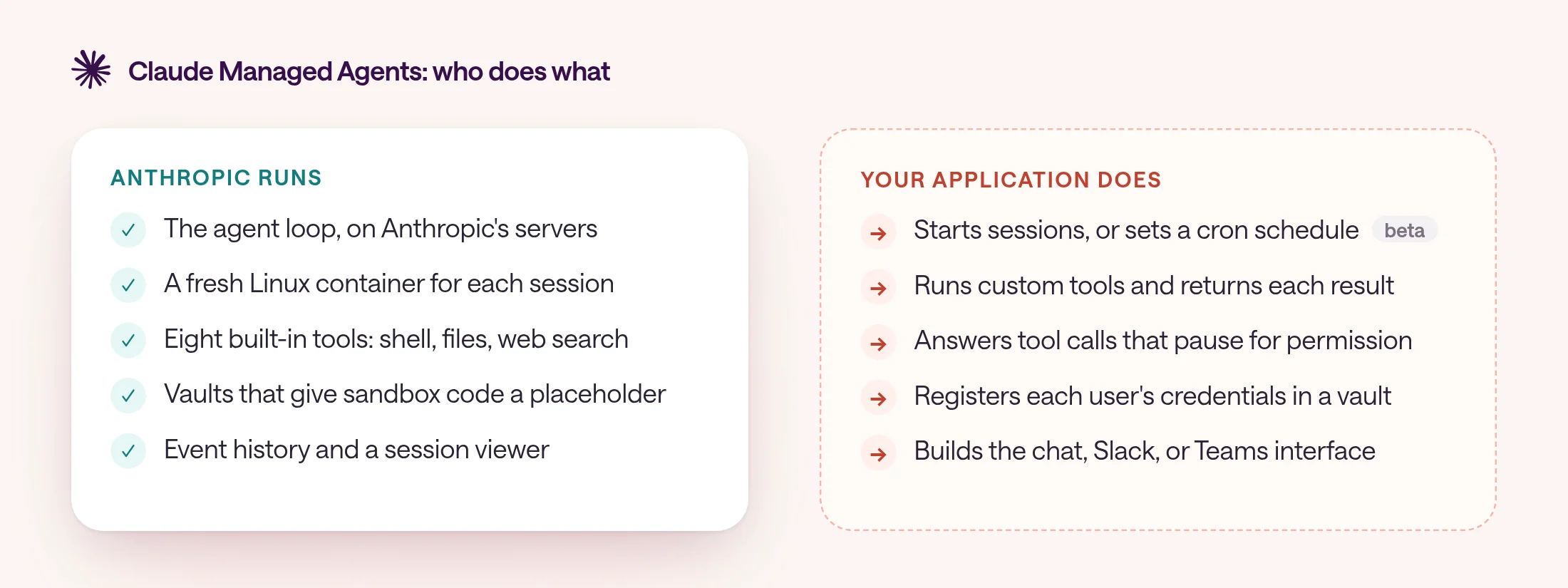
Anthropic describes Claude Managed Agents as a suite of composable APIs for building and deploying cloud-hosted agents. It provides the harness: the agent loop runs on Anthropic's servers with prompt caching and compaction built in, and each session gets a fresh Linux container with eight built-in tools for shell commands, files, and web search. Agents connect to remote MCP servers, and vaults keep credentials out of the sandbox: code sees a placeholder, and the real secret is added only to outgoing requests.
It is a developer product. Your application starts sessions, runs custom tools, answers tool calls that pause for permission, and builds the interface people use. Anthropic's quickstart renders a chat surface, and a Chat SDK adapter moves the same handler to Slack or Teams. Scheduled deployments, in public beta, add cron schedules. Pricing is model tokens plus $0.08 per session-hour while a session is running, according to Anthropic's pricing page.
The usual reasons to compare alternatives: you need models other than Claude, you want triggers and a team interface without building them, your company has committed to AWS, Azure, or Google Cloud, or the people who will use the agent are your own team rather than your product's users.
What is a managed agent platform?
A managed agent platform runs an AI agent for you: the agent loop, an isolated sandbox for its tools, credentials for the apps it uses, and a record of each run. The options differ in how much you still build around the agent, which models it can use, and who works with the result.
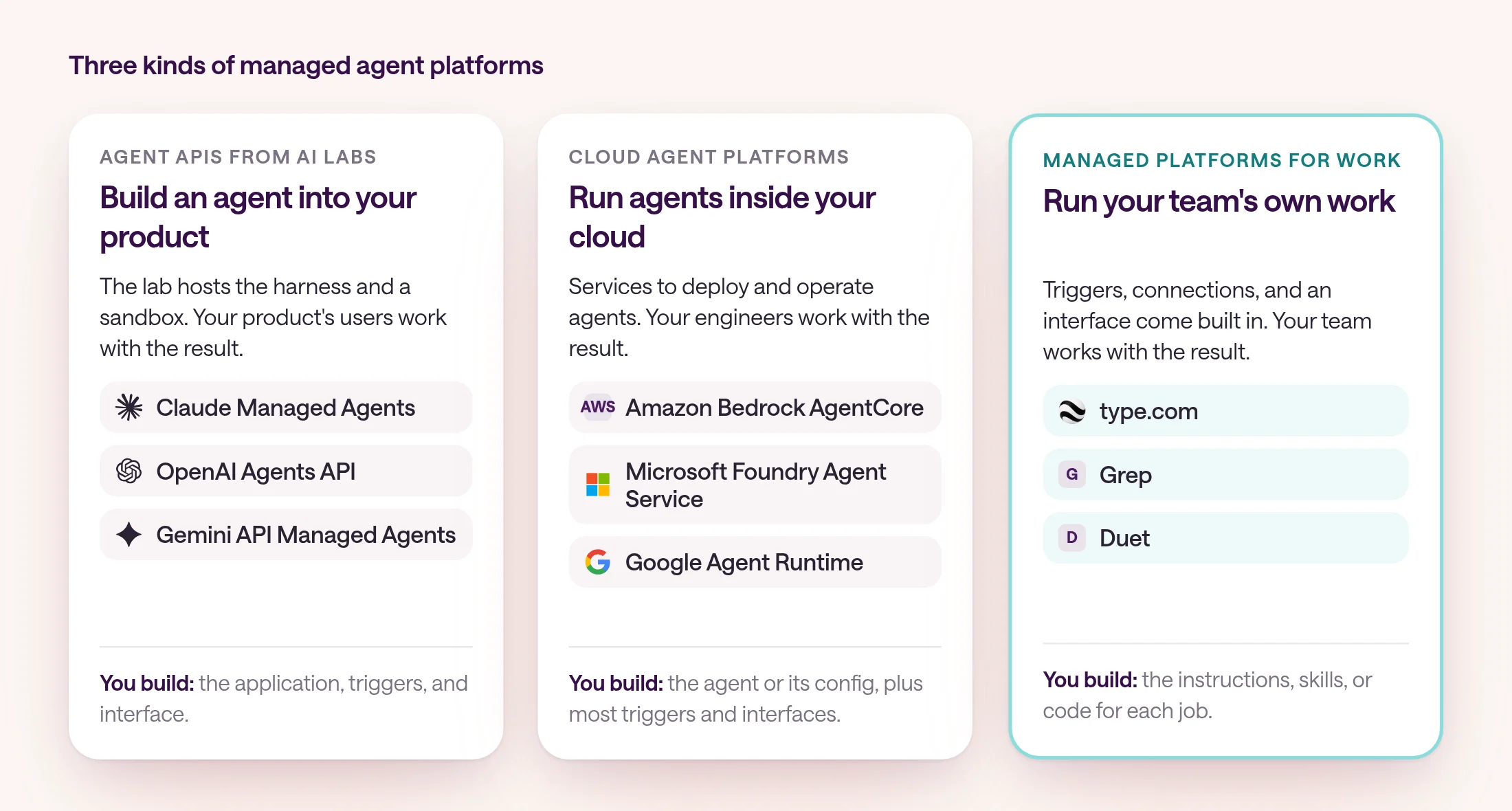
The options fall into three groups. Agent APIs from AI labs, such as Claude Managed Agents, the OpenAI Agents API, and Gemini API Managed Agents, host a harness and a sandbox for developers to build products on. Cloud agent platforms, such as Amazon Bedrock AgentCore, Microsoft Foundry Agent Service, and Google Agent Runtime, give developers the services to deploy and operate agents inside the cloud they already use. Managed platforms for a team's work, such as type.com, Grep, and Duet, add triggers, connections, and an interface, so a team describes the work and the platform runs it.
No group is better in general. An agent API is the right base for an agent inside your product, a cloud platform is the right base for engineers who already run everything on that cloud, and a managed platform is the right choice when the people using the agent are your own team.
How do the Claude Managed Agents alternatives compare?
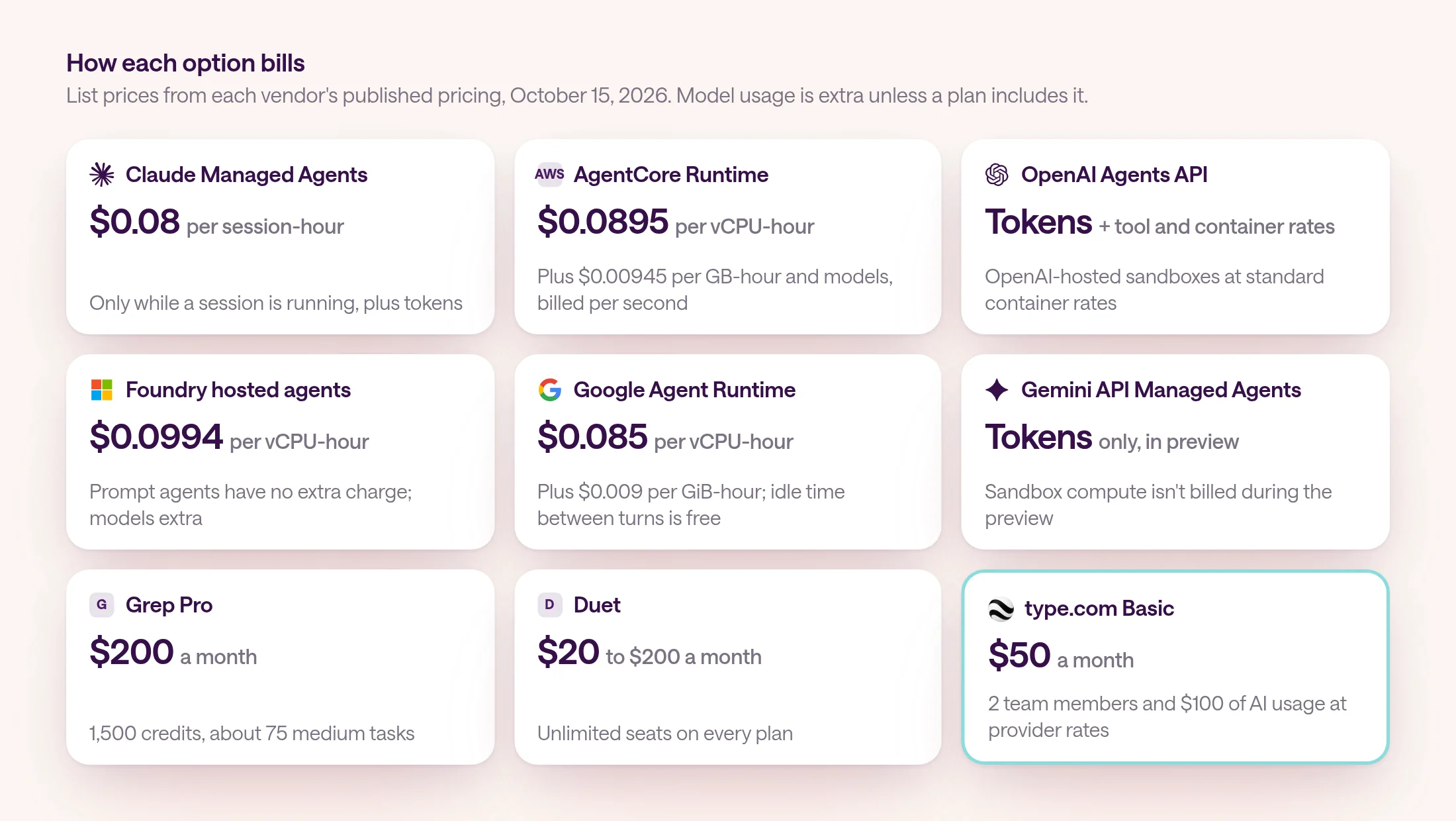
Here are Claude Managed Agents and eight alternatives side by side, checked against each vendor's own documentation on October 15, 2026. The biggest differences are what you still build, which models run, and whether runs can start on their own.
Model usage is extra everywhere except where a plan includes it: type.com plans include AI usage metered at the provider's API rates, and Grep and Duet sell credits. Where a column says none are documented, agents start from API calls you make or from infrastructure you set up.
| Option | What it is | Models | Built-in triggers | Pricing |
|---|---|---|---|---|
| type.com | Managed agent platform for a team's automations | Claude and Codex | Schedules, Slack, GitHub, Linear, webhooks, email, RSS | From $50 a month for 2 team members, AI usage at provider rates |
| Claude Managed Agents | Agent API from Anthropic, public beta | Claude | Cron schedules, public beta | Tokens plus $0.08 per session-hour |
| Amazon Bedrock AgentCore | Agent services on AWS | Any model | None documented | From $0.0895 per vCPU-hour plus $0.00945 per GB-hour, plus models |
| OpenAI Agents API | Managed Codex harness from OpenAI, public beta | OpenAI models | None documented | Tokens plus tool and container rates |
| Microsoft Foundry Agent Service | Agent service on Azure | Azure OpenAI and Foundry models, Claude through Agent Framework | Cron, timer, GitHub issue, Teams message | No extra charge for prompt agents; hosted agents from $0.0994 per vCPU-hour; plus models |
| Google Agent Runtime | Agent runtime on Google Cloud | Any model your code calls | None documented | $0.085 per vCPU-hour plus $0.009 per GiB-hour, plus models |
| Gemini API Managed Agents | Agent API from Google, public preview | Gemini | Cron schedules | Gemini tokens; sandbox compute free during the preview |
| Grep | Managed agents for research and compliance | Claude, GPT, DeepSeek, and open-source, chosen per step | Schedules, monitors, batches | Pro $200 a month for 1,500 credits |
| Duet | Agent workspaces for consultants and their clients | Claude, GPT, and Kimi, chosen by quality tier | Schedules, events, webhooks | $20, $50, or $200 a month, unlimited seats |
When is type.com the right Claude Managed Agents alternative?
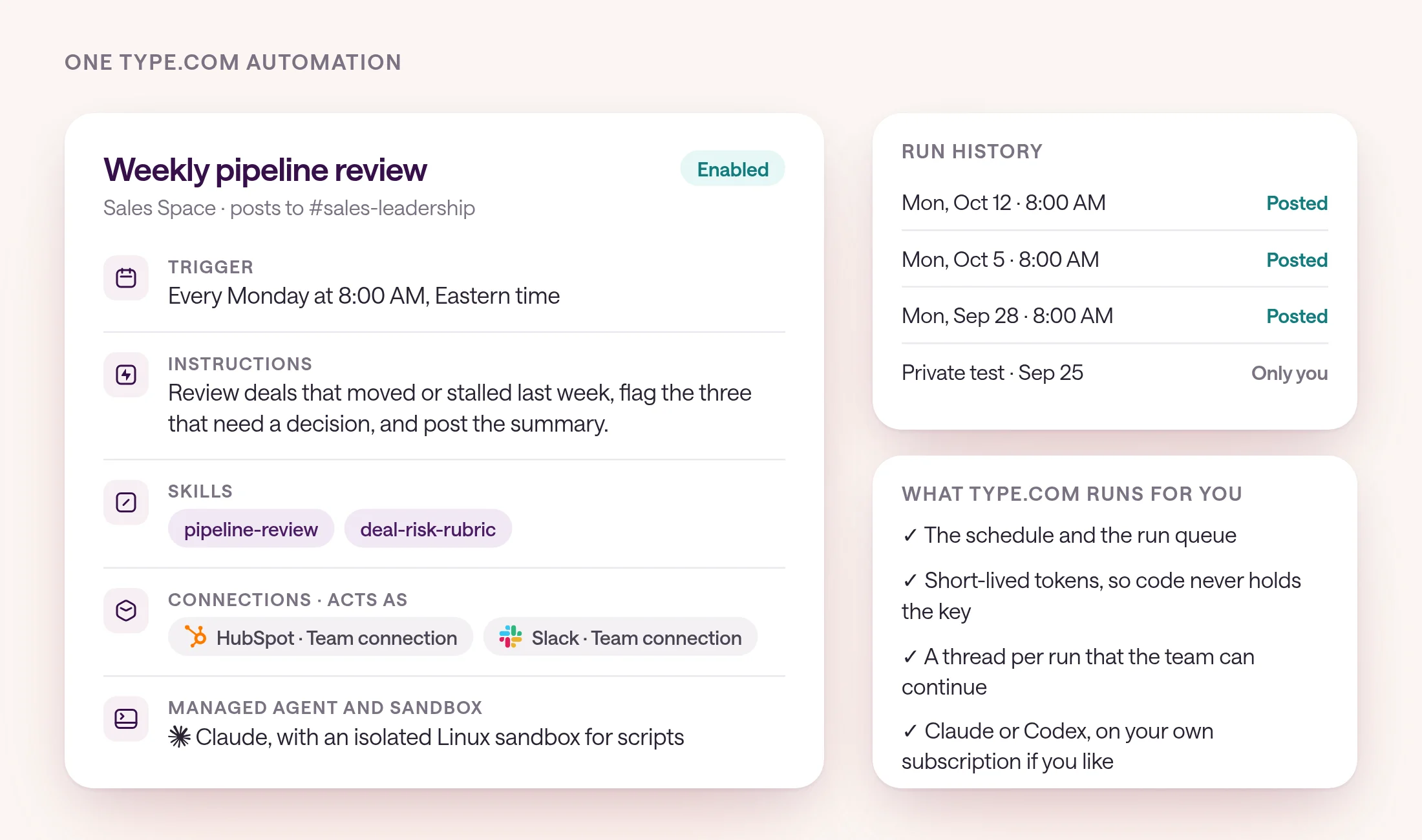
Pick type.com when the agent's job is your team's own recurring work, such as reports, triage, reviews, and handoffs, and you want it running without building an application around it. Each type.com automation comes with a managed Claude or Codex agent, and each run can use code, skills, and a sandbox.
You describe the job in a Space, or write it in TypeScript and deploy it with the type.com CLI. Automations start from schedules (every minute to once a month), Slack messages, GitHub and Linear events, webhooks, emails sent to a Space, or RSS items. Each run makes a thread with the agent's messages and tool calls that the team can read and continue, and run history records the output and any errors. How type.com automations work covers a run from trigger to result.
Connections are added once, through OAuth sign-in, API keys, service accounts, or hosted MCP servers, and assigned to the Spaces that need them. Each run gets a short-lived token, so automation code never holds a provider credential, and scheduled runs act as the person who created the automation. Code can do the fixed steps and hand judgment to the agent in the same automation. Code automations are in early access.
Plans start at $50 a month for 2 team members with $100 of AI usage, metered at the provider's API rates, and team members can connect their own Claude or ChatGPT subscriptions. See type.com pricing and the full type.com vs Claude Managed Agents comparison.
- Best for: teams automating their own work across business tools.
- You still build: nothing around the agent. Describe the job or write code.
- Models: Claude and Codex.
- Pricing: from $50 a month for 2 team members, with AI usage at provider rates.
When is Amazon Bedrock AgentCore the right alternative?
Pick AgentCore when your agents belong inside AWS and your developers want any model and any framework. It is a set of AWS services for building, deploying, and operating agents, not a finished product for your team.
Amazon Bedrock AgentCore became generally available in October 2025. Its managed harness, generally available since June 2026, runs an agent you declare in configuration on a loop built on Strands Agents. Or you write the loop in LangGraph, CrewAI, Google ADK, the OpenAI Agents SDK, or another framework and deploy it to Runtime, where each session gets its own microVM for up to 8 hours. Gateway turns APIs, Lambda functions, and MCP servers into tools, Identity keeps credentials in a token vault, and Policy checks each tool call.
Agents start when your code calls the API, including from AWS Step Functions, and the documentation doesn't describe a built-in scheduler. AWS points business users to Amazon Quick, a separate product. Pricing is consumption-based: Runtime is $0.0895 per vCPU-hour and $0.00945 per GB-hour, billed per second, plus model usage, according to AgentCore pricing. See type.com vs Amazon Bedrock AgentCore for the full comparison.
- Best for: developers and platform teams on AWS.
- You still build: the agent's triggers, tool setup, and interface.
- Models: any, in or outside Amazon Bedrock.
- Pricing: consumption-based, from $0.0895 per vCPU-hour.
When is the OpenAI Agents API the right alternative?
Pick the OpenAI Agents API when you build on OpenAI models and want OpenAI to run the agent for your product. It is OpenAI's closest equivalent to Claude Managed Agents: a managed Codex harness, in public beta since September 2026.
The Agents API gives your application access to the Codex harness through an OpenAI-managed API. OpenAI manages sessions, orchestration, context compaction, and recovery. The agent runs in an OpenAI-hosted Linux sandbox, in a sandbox you host with a provider such as Modal or Daytona, or with no sandbox. It supports MCP servers, web search, computer use, and vaults that give the sandbox a placeholder instead of the secret.
Your application server submits tasks, handles function tools, and supplies the interface and the triggers; OpenAI's own Slack example runs Slack access and credentials in your app. Model usage is billed at each model's API rates, plus standard rates for tools and OpenAI-hosted containers. Agent Builder, OpenAI's visual builder, shuts down on November 30, 2026, and OpenAI points no-code builders to ChatGPT workspace agents.
- Best for: developers building products on OpenAI models.
- You still build: the application server, triggers, and interface.
- Models: OpenAI models.
- Pricing: model tokens plus tool and container rates.
When is Microsoft Foundry Agent Service the right alternative?
Pick Foundry Agent Service when your company runs on Azure and Microsoft 365. Of the cloud options, it has the most built in for business users: scheduled routines, and agents published to Teams and Microsoft 365 Copilot.
Foundry Agent Service is Microsoft's generally available platform for building, deploying, and scaling agents. Prompt agents are defined entirely in configuration. Hosted agents, generally available since July 2026, run your own code from Agent Framework, LangGraph, the OpenAI Agents SDK, Anthropic's agent SDK, or a framework of your own, each in per-session VM-isolated sandboxes with its own Microsoft Entra identity. Models include Azure OpenAI and other Foundry models, and Claude works through Microsoft Agent Framework.
Routines, generally available since September 2026, start agents on a cron schedule as often as every five minutes, on a timer, from a GitHub issue, or from a Teams channel message, and agents can be published to Teams and Microsoft 365 Copilot. Prompt agents carry no extra charge, hosted agents bill container compute from $0.0994 per vCPU-hour, and models are billed separately.
- Best for: companies on Azure and Microsoft 365.
- You still build: the agent and its tools. Routines and Teams delivery are built in.
- Models: Azure OpenAI and Foundry models, with Claude through Agent Framework.
- Pricing: no extra charge for prompt agents; hosted agents from $0.0994 per vCPU-hour.
When is Google Agent Runtime the right alternative?
Pick Agent Runtime when your agents belong on Google Cloud and your developers write them in ADK, LangGraph, or another framework. It is the runtime formerly called Vertex AI Agent Engine, now part of Gemini Enterprise Agent Platform.
Google renamed Agent Engine to Agent Runtime on April 22, 2026, when Agent Builder became part of Gemini Enterprise Agent Platform. You deploy agent code built with ADK, LangChain, LangGraph, AG2, LlamaIndex, or a custom container, and Google runs and scales it, with per-agent identities, IAM, and an Agent Gateway that governs tool calls. Agents can call Gemini or partner models such as Claude.
Agents start from API calls, and the documentation doesn't describe a built-in cron trigger. Pricing is $0.085 per vCPU-hour and $0.009 per GiB-hour, idle time between turns isn't billed, and the first 50 vCPU-hours and 100 GiB-hours each month are free.
- Best for: developers on Google Cloud.
- You still build: the agent code, its triggers, and its interface.
- Models: any model your code calls, including Gemini and Claude.
- Pricing: $0.085 per vCPU-hour plus $0.009 per GiB-hour.
When are Gemini API Managed Agents the right alternative?
Pick Gemini API Managed Agents when you build on Gemini models and want Google to run the harness and the sandbox. It is Google's closest equivalent to Claude Managed Agents, in public preview since May 2026.
Managed agents in the Gemini API give you a configurable agent harness. One API call provisions a Google-hosted Linux sandbox where the agent reasons, runs code, and manages files, and you define the agent in Markdown files such as AGENTS.md and SKILL.md. Triggers run an agent on a cron schedule, credentials stay outside the agent's environment, and the agent can use remote MCP servers.
Models are Gemini only, and an agent's model is fixed when you create it. Sandbox compute isn't billed during the preview, so you pay Gemini token rates.
- Best for: developers building on Gemini models.
- You still build: the application and interface around the agent.
- Models: Gemini.
- Pricing: Gemini token rates; sandbox compute free during the preview.
When is Grep the right alternative?
Pick Grep when the work is research and compliance, such as business verification, sanctions screening, due diligence, or vendor review. Grep calls itself a managed agent workforce: it runs the harness and picks the models for you.
In Grep, you describe the job in plain English or a few lines of code. Grep runs each job in a fresh sandbox with research data sources and skills, and chooses Claude, GPT, DeepSeek, or open-source models for each step. Agents run on schedules, as monitors that watch for changes, or in batches, and results arrive in an inbox or by email.
Pricing is credit-based. Pro is $200 a month for 1,500 credits, about 75 medium tasks, and Ultra is $500 a month for 4,500 credits, according to Grep's pricing page.
- Best for: compliance and research teams.
- You still build: the job description. Grep picks models and runs the harness.
- Models: Claude, GPT, DeepSeek, and open-source models, chosen per step.
- Pricing: Pro $200 a month for 1,500 credits.
When is Duet the right alternative?
Pick Duet when you are a consultant or agency turning your expertise into agents that clients and teammates use. Duet calls itself the managed agent platform and gives each workspace its own virtual machine.
Duet gives each workspace a dedicated single-tenant VM, keeps models behind one gateway (Claude, GPT, and Kimi models, chosen by quality tier), and handles sign-in and billing. You maintain the agent's instructions, skill files, and memory. Agents run on schedules, wake on events, and listen for webhooks, and people you invite can talk to every agent in the workspace.
Plans are $20, $50, or $200 a month, each with unlimited seats, according to Duet's pricing page.
- Best for: consultants and agencies sharing agents with clients.
- You still build: the agent's instructions, skills, and memory.
- Models: Claude, GPT, and Kimi models, chosen by quality tier.
- Pricing: $20, $50, or $200 a month, unlimited seats.
When should you self-host the Claude Agent SDK instead?
Self-host when you want Claude's agent loop inside your own infrastructure and your engineers will run the hosting, scheduling, and credentials. Anthropic documents this path for the Claude Agent SDK.
Per Anthropic's Agent SDK hosting guide, the SDK runs a claude CLI subprocess with its own shell, working directory, and session files, so each agent needs a container. Anthropic suggests 1 GiB of RAM, 5 GiB of disk, and 1 CPU per agent as a starting point, and estimates a minimally provisioned container at roughly $0.05 an hour before tokens.
Everything around the loop is yours: keeping tool credentials out of the agent's environment, adding timeouts, starting runs on a schedule or an event, and building the interface people use. That is the work a managed agent platform does for you.
How do you choose a Claude Managed Agents alternative?
Start with who works with the result. Then check what starts the work, which models you need, where credentials live, and what a real week of runs costs in each option you shortlist.
Most teams can rule out half the options with the first question alone.
- 1
Decide who works with the result
If your product's users do, start with an agent API: Claude Managed Agents, the OpenAI Agents API, or Gemini API Managed Agents. If your engineers do, inside the cloud you already use, look at AgentCore, Foundry Agent Service, or Agent Runtime. If your whole team does, look at a managed platform such as type.com, Grep, or Duet.
- 2
List what starts the work
Write down the schedules, Slack messages, GitHub events, webhooks, and emails that should start a run. Some options have these built in. With the rest, you build that part.
- 3
Check the models
Claude Managed Agents runs Claude, the OpenAI Agents API runs OpenAI models, and Gemini API Managed Agents runs Gemini. AgentCore and Agent Runtime run whatever your code calls. type.com runs Claude and Codex.
- 4
Check credentials and identity
Ask where each credential is stored, whether code can read it, and whose account a run acts as when it writes to your CRM or posts to Slack.
- 5
Price a real workload
Session-hours, vCPU-hours, credits, and plans with metered AI usage don't compare on a pricing page. Price one week of your real runs in each option you shortlist.
Frequently asked questions
What is the best alternative to Claude Managed Agents?
It depends on who works with the result. For a team's own automations, type.com runs Claude or Codex with built-in triggers and a thread for every run. For developers on AWS, Azure, or Google Cloud, Amazon Bedrock AgentCore, Microsoft Foundry Agent Service, or Google Agent Runtime fit those clouds. For products built on other models, the OpenAI Agents API and Gemini API Managed Agents are the closest equivalents.
Does OpenAI have an equivalent to Claude Managed Agents?
Yes. The OpenAI Agents API, in public beta since September 2026, gives your application a managed Codex harness with an OpenAI-hosted or self-hosted sandbox. Like Claude Managed Agents, it leaves the triggers and the interface to your application.
Which Claude Managed Agents alternatives can run Claude models?
type.com runs Claude and Codex. Amazon Bedrock AgentCore and Google Agent Runtime can use Claude through your agent code, Microsoft Foundry supports Claude through Microsoft Agent Framework, and Grep and Duet route some work to Claude models. The OpenAI Agents API and Gemini API Managed Agents run their own providers' models.
Which alternatives can run agents on a schedule?
type.com, Microsoft Foundry Agent Service, Gemini API Managed Agents, Grep, and Duet have schedules built in, and Claude Managed Agents has cron schedules in public beta. Amazon Bedrock AgentCore, Google Agent Runtime, and the OpenAI Agents API start agents from API calls that you make.
Can I self-host Claude Managed Agents?
Partly. Claude Managed Agents can run tools in a sandbox you host while Anthropic keeps the agent loop. To run the whole loop yourself, self-host the Claude Agent SDK, which Anthropic documents for your own infrastructure, and build the scheduling, credentials, and interface around it.
How much do Claude Managed Agents alternatives cost?
The pricing units differ. Claude Managed Agents charges tokens plus $0.08 per session-hour. AgentCore, Foundry hosted agents, and Google Agent Runtime charge for compute by the vCPU-hour, plus models. Grep and Duet sell monthly plans, from $200 and $20. type.com plans start at $50 a month for 2 team members, with AI usage metered at the provider's API rates.