Comparison guide
OpenClaw vs managed agent platforms for teams
Cost, security, team use, and upkeep, from OpenClaw's own docs, with where each option wins.
Should your team use OpenClaw or a managed agent platform?
Choose OpenClaw if you want free, open-source software, any model including local ones, and someone on the team who will run and secure an always-on gateway. Choose a managed agent platform if you want the runtime, sandboxing, schedules, and team access handled for you, and you would rather pay for that than operate it.
OpenClaw is the best-known open-source agent of 2026, with more than 390,000 GitHub stars on October 15, 2026. It runs as a gateway on hardware you control and talks to you through the chat apps you already use. A managed agent platform runs the agent in the vendor's cloud instead. Some are runtimes that developers build products on, such as Claude Managed Agents and Amazon Bedrock AgentCore. Others, such as type.com, are ready for a business team to use directly.
We make type.com, which is a managed agent platform, so weigh our view with that in mind. Every OpenClaw fact below comes from OpenClaw's own docs, README, security policy, and blog, checked on October 15, 2026, with links. Older comparisons describe OpenClaw as single-user with no permissions. That was true of early versions, but current releases support shared team gateways, so we describe those. type.com can also connect to your OpenClaw, which we cover at the end.
- OpenClaw: free software, any model, your hardware, your operations.
- Managed platform: a monthly or usage bill, and the vendor runs the agent, sandbox, and schedules.
- The deciding questions are who keeps it running, who keeps it secure, and whether people who don't fully trust each other need to share it.
What is OpenClaw?
OpenClaw is a free, MIT-licensed, self-hosted gateway that connects chat apps such as WhatsApp, Telegram, Slack, and iMessage to an AI agent that runs on your own computer or server. The OpenClaw Foundation, an independent nonprofit, maintains it.
You install it with npm, Docker, or a desktop app for macOS, Windows, or Linux, and OpenClaw's getting-started guide says your first chat takes about five minutes. A single gateway process handles routing, channel connections, and a built-in scheduler. It works in 29 chat channels, in direct messages and group chats.
OpenClaw is model-agnostic. You can use API keys for Anthropic, OpenAI, OpenRouter, and other providers, sign in with a Claude or ChatGPT subscription, or run local models so your data stays on your device. Skills are markdown instruction files, and ClawHub is the public registry where anyone can publish skills and plugins.
The Foundation sells nothing: there is no paid tier and no hosted service. OpenClaw Enterprise, announced on September 29, 2026, is a free, self-hosted project for managing agents in sensitive environments, and the Foundation says it is ready for internal pilots. The closest thing to a managed OpenClaw comes from a third party: Microsoft's Autopilot, part of its new Copilot experience, is built on OpenClaw.
What is a managed agent platform?
A managed agent platform runs the agent for you. The vendor hosts the agent loop, gives each run an isolated sandbox, keeps credentials away from the agent's code, and records what happened. You supply the instructions, and on some platforms the code.
Managed agent platforms come in two kinds. Developer runtimes, such as Claude Managed Agents, the OpenAI Agents API, and Amazon Bedrock AgentCore, host the harness and sandbox for engineers who build the product, users, and interface around them. Claude Managed Agents, for example, charges model tokens plus $0.08 per session-hour while a session runs.
Team platforms, such as type.com, Duet, and Grep, add the parts a business team needs, such as connections to its tools, triggers and schedules, and a place to read the results. For a full list with prices, see our guide to Claude Managed Agents alternatives.
How does OpenClaw compare with managed agent platforms?
OpenClaw gives you the most control and the lowest software cost, and asks you to run everything. A developer runtime runs the agent but leaves the product to you. A team platform such as type.com runs the agent and includes the team-facing parts.
The table compares OpenClaw with one developer runtime and one team platform, using each product's own documentation as of October 15, 2026.
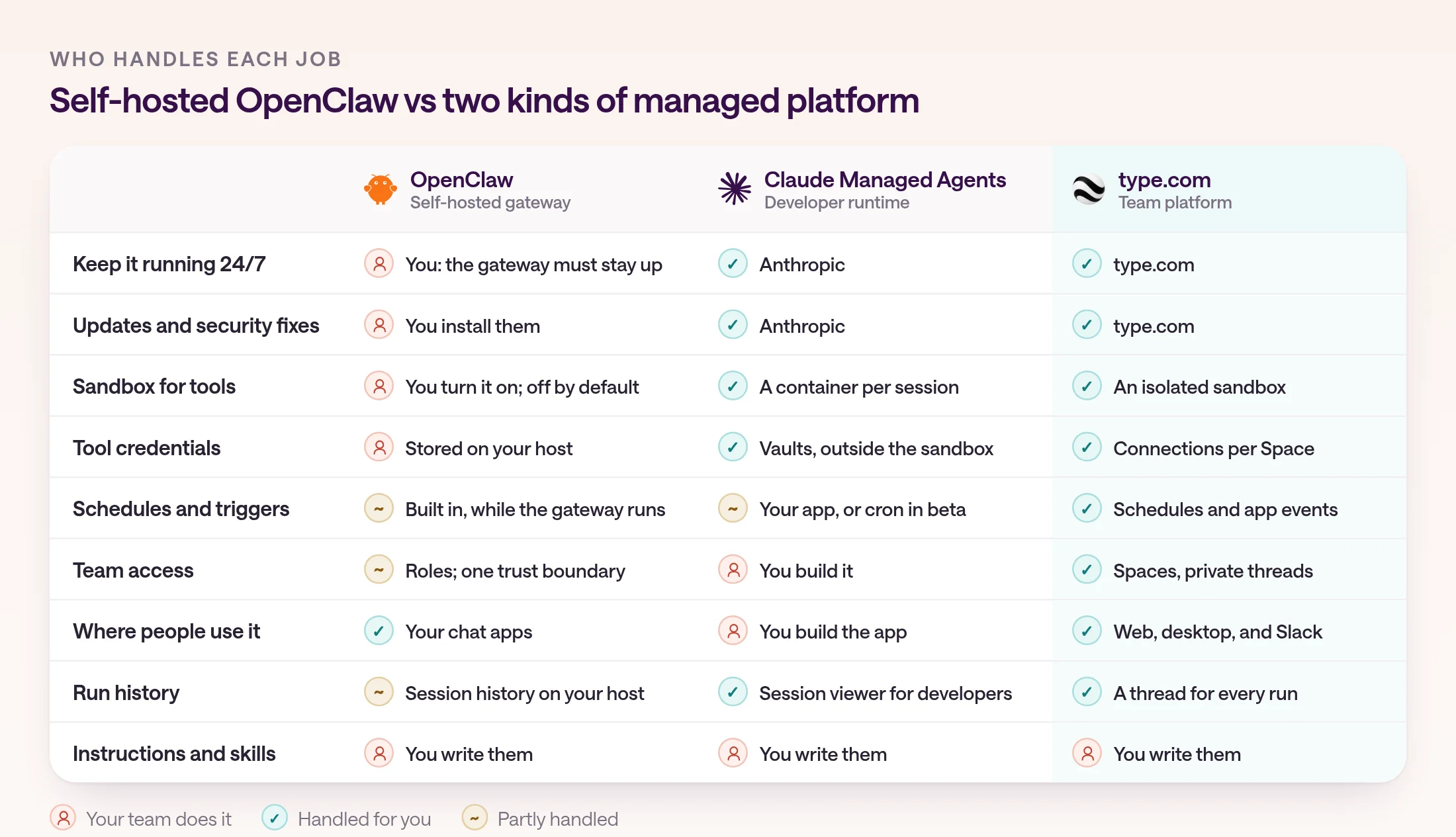
| Question | OpenClaw | Claude Managed Agents | type.com |
|---|---|---|---|
| Who runs it | You, on a computer, VPS, or Kubernetes cluster | Anthropic, or a sandbox you host | type.com, in its cloud |
| Software price | Free, MIT license | $0.08 per session-hour while running, plus tokens | From $50/month for 2 members, with $100 of AI usage |
| Models | Any provider, a Claude or ChatGPT subscription, or local models | Claude | Claude or Codex, on the workspace allowance or your own subscription |
| Where people use it | 29 chat apps, including WhatsApp, Telegram, Slack, and iMessage | The app you build | type.com on the web and desktop, and Slack |
| Schedules and triggers | Cron, intervals, and webhooks, while the gateway runs | Cron schedules in public beta; your app starts sessions | Schedules, Slack, GitHub, Linear, webhooks, email, and RSS |
| Isolation | Tools run on the host unless you turn on sandboxing | A fresh container per session | An isolated sandbox; code automations never receive a provider credential |
| Team use | Shared gateway with roles; one gateway is one trust boundary | Users and permissions are yours to build | Spaces with shared connections, skills, and memory; private threads |
| Updates | You install releases and security fixes | Anthropic | type.com |
What does OpenClaw cost compared with a managed platform?
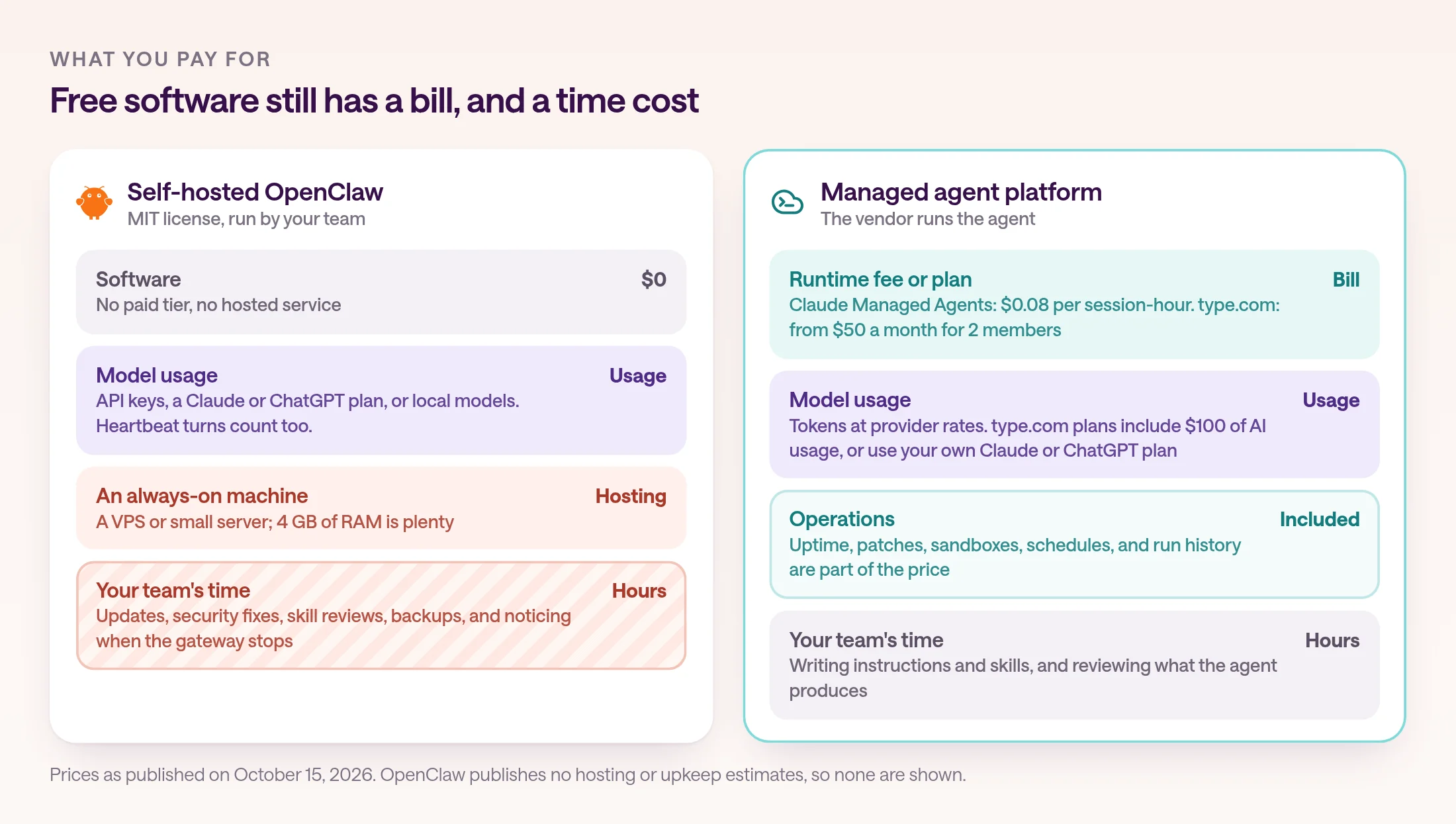
OpenClaw's software is free, but you pay for model usage, a machine that stays on, and the time to run it. Managed platforms charge for the runtime or a plan, plus model usage, and the operations are included.
Model usage is the first cost either way. With OpenClaw you can use pay-as-you-go API keys, a Claude or ChatGPT subscription, or local models, and its FAQ calls an Anthropic API key the more predictable choice for long-lived gateway hosts and shared automation. The heartbeat that keeps OpenClaw proactive runs a full agent turn every 30 minutes by default, and its docs warn that shorter intervals burn more tokens.
Hosting is second. A laptop has no server cost but disconnects when it sleeps, so OpenClaw's docs suggest a VPS for 24/7 use, and say a small VPS or Raspberry Pi-class box with 4 GB of RAM is plenty. Their hosting guides cover providers such as DigitalOcean, Hetzner, Fly.io, and Oracle's free tier.
The third cost is time, and OpenClaw publishes no estimate for it, so we won't either. Someone has to install releases and security fixes, review skills before enabling them, back up the state directory that holds credentials, and notice when the gateway stops. On a managed platform, those jobs are part of what you pay for: Claude Managed Agents charges $0.08 per session-hour plus tokens, and type.com plans start at $50 a month for two members with $100 of AI usage at provider rates, or your own connected Claude or ChatGPT subscription.
Is OpenClaw secure enough for a team?
It can be, with configuration and upkeep. OpenClaw's docs say the default is a trusted single-operator assistant with sandboxing and exec approvals off, that one gateway is one trust boundary, and that the gateway should never be exposed to the public internet.
OpenClaw's security policy describes a personal-assistant model: one trusted operator, possibly many agents, and not a shared multi-tenant system. Tools run on the host unless you configure sandboxing, and OpenClaw's own docs call its sandbox a meaningful limit rather than a perfect security boundary. Credentials and private data live under the ~/.openclaw directory on that host.
Skills and plugins need the same care. ClawHub scans every upload, but its docs say audits are strong signals, not guarantees, and tell you to treat third-party skills as untrusted code. Plugins load inside the gateway process as trusted code. OpenClaw also warns that the model itself is not a trusted principal, so content from email, web pages, or chat can try to steer it.
OpenClaw's security process is open, which is good, and active: its docs counted 647 published advisories as of August 27, 2026. That also tells you how often whoever runs your gateway will be applying fixes.
A managed platform moves those jobs to the vendor. Claude Managed Agents starts a fresh container for each session and keeps secrets in vaults, so code in the sandbox sees a placeholder. In type.com, connections are assigned to a Space, so a run can only use the tools that Space has, and a code automation gets a short-lived token for each run instead of a provider credential.
Can a team share one OpenClaw?
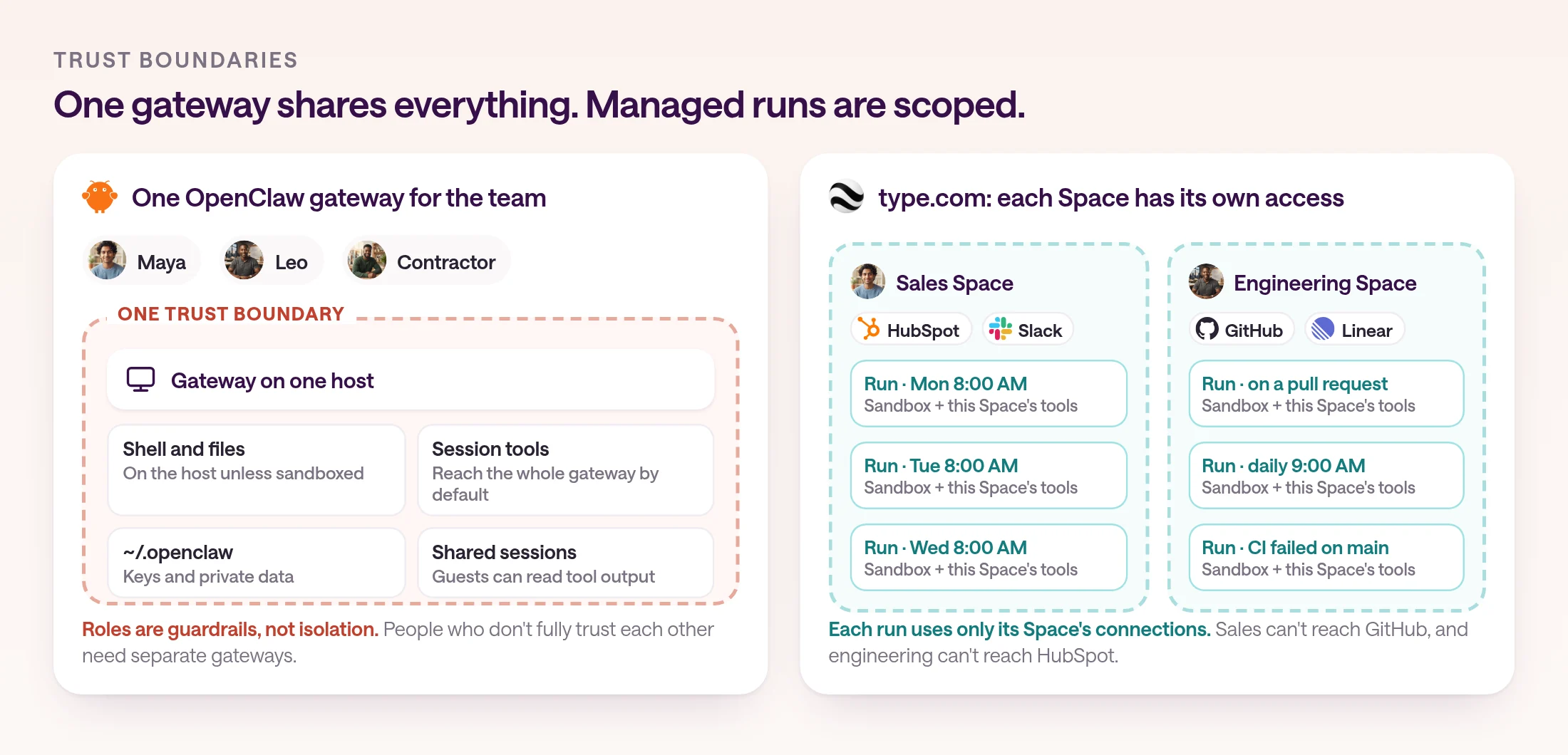
Yes. A shared gateway is a supported setup, with multi-user sessions and named operator roles. Everyone on that gateway shares one trust boundary, though: guests can read every shared session, including tool output, so people who don't fully trust each other need separate gateways.
OpenClaw's team guide calls team operation a matter of configuration, not a separate edition. Sessions record who created, owns, and prompted them, the gateway keeps a metadata-only audit log, and named roles limit which sessions and agents each person can use. Roles are recent, so the docs advise checking your installed version before you rely on them.
The same docs set clear limits. Session ownership and visibility are usability features, not security boundaries, and for people or organizations who don't trust each other, the advice is one gateway per tenant. The security guide adds: use separate agents or gateways with minimal tools for team workflows, and keep agents with personal data private.
Team platforms start from the other end. In type.com, work happens in Spaces with their own channels, memory, skills, and connections. Admins assign each connection to the Spaces that should use it, threads can be private, and a scheduled automation acts as the person who created it, with that person's access.
- A few trusted teammates sharing one assistant: OpenClaw's shared gateway works.
- Several teams, contractors, or clients: plan one gateway per trust boundary, or use a platform with per-team access.
- Personal accounts and personal data: keep them off any shared OpenClaw host.
When is OpenClaw the better choice?
OpenClaw is the better choice when control matters more than convenience: you want local or any-provider models, data on your own hardware, deep customization, and you have someone who enjoys running infrastructure.
OpenClaw is excellent at being a personal assistant in the apps you already use. It reaches you on WhatsApp, iMessage, or Telegram, can run on a Mac mini at home, and changes as fast as its open-source community does. For a technical founder or a small team of engineers who trust each other, it can be the most capable and least expensive option.
- You want to run local models, or switch providers freely.
- Your data must stay on hardware you control.
- You want the assistant in personal chat apps like WhatsApp or iMessage.
- One person, or a few people who trust each other, will use it.
- Someone will own updates, security fixes, backups, and uptime.
When is a managed agent platform the better choice?
A managed agent platform is the better choice when the agent does work for a team, has to run reliably without anyone babysitting a machine, or touches company systems that need access controls and an audit trail.
Most business teams want the output, not the infrastructure: a Monday pipeline review, a support digest every morning, research on every new lead. Those jobs need to run on time, use the company's tools with the right permissions, and leave a record the team can check. That is what a managed platform sells.
Pick the kind that matches who uses the agent. If your engineers are building an agent into your product, a developer runtime such as Claude Managed Agents or Amazon Bedrock AgentCore is the right base. If the agent works for your own team, a team platform such as type.com, Duet, or Grep saves you building the interface, triggers, and permissions.
- Several people or teams need to share the agent's work.
- Jobs must run on schedule even when every laptop is closed.
- The agent uses company systems that need scoped access.
- Nobody on the team wants to run and patch a gateway.
- You need run history to see what the agent did, and why a run failed.
Can you use OpenClaw with type.com?
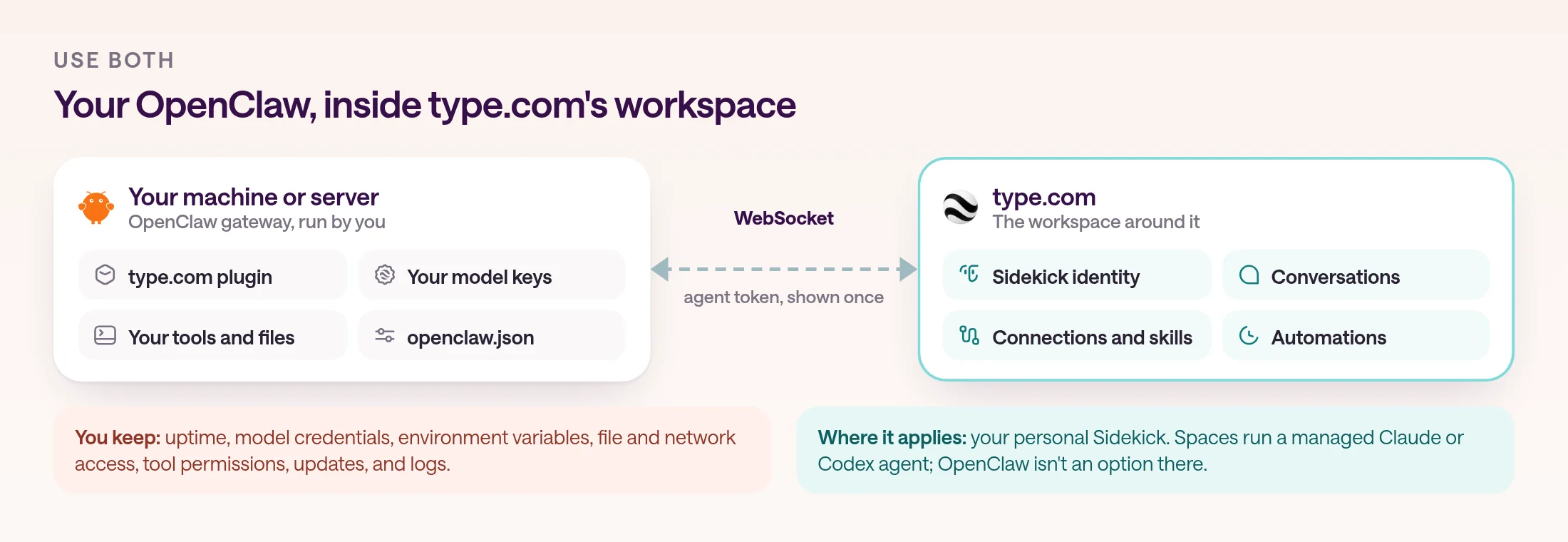
Yes, for your personal Sidekick. type.com can use your own OpenClaw runtime to power Sidekick: type.com provides the workspace, conversations, permissions, connections, skills, and automations, while OpenClaw runs on infrastructure you control.
Sidekick is your private place to work with AI in type.com. During Sidekick setup, choose to use your own OpenClaw, install the type.com plugin on the machine running OpenClaw, merge the generated settings into openclaw.json, and restart the gateway. The full steps are in Connect Your Own OpenClaw.
Know the limits before you set it up. OpenClaw powers your Sidekick only, and it isn't an option when you create a Space, where type.com runs a managed Claude or Codex agent. You stay responsible for the runtime's uptime, model credentials, environment variables, file and network access, tool permissions, updates, and logs. Set OpenClaw to full verbose output so type.com receives complete tool output, and keep the agent token private, because type.com shows it only once.
- 1
Start Sidekick setup and choose your OpenClaw
Name your Sidekick, select Use your OpenClaw instead, and review the generated OpenClaw identity and username.
- 2
Install the type.com plugin
On the machine running OpenClaw, install @type-dot-com/type-openclaw-plugin in ~/.openclaw/plugins/type.
- 3
Merge the generated settings
Copy the setup instructions into ~/.openclaw/openclaw.json. They include the agent token, agent ID, and WebSocket URL.
- 4
Restart the gateway and check it
Run openclaw gateway restart, then openclaw channels status, and start chatting with Sidekick in type.com.
How should your team decide?
Decide by who will use the agent and who will run it. A personal assistant for someone technical points to OpenClaw. Recurring work for a business team points to a managed platform.
Run one real workflow both ways if you can. Give OpenClaw a week on a spare machine and the same job a week on a managed platform, then compare the output, the time someone spent keeping it working, and the bill. type.com starts with a 14-day trial, and you can test an automation privately before it runs on a schedule.
- 1
Name who uses the agent
One person, a small group that trusts each other, or several teams. More than one trust boundary means more than one OpenClaw gateway.
- 2
Name who keeps it running
If nobody owns updates, security fixes, backups, and uptime, choose a managed platform.
- 3
List the systems it touches
Company systems with sensitive data favor scoped connections, per-run isolation, and run history.
- 4
Price the real usage
Estimate model usage for the job on both options, then add hosting and time for OpenClaw, or the plan or runtime fee for a managed platform.
Frequently asked questions
Is OpenClaw free?
Yes. OpenClaw is MIT-licensed open source, and the OpenClaw Foundation sells nothing: no paid tier and no hosted service. You still pay for model usage, through API keys or a Claude or ChatGPT subscription, and for any machine you run it on, unless you use local models on hardware you already own.
Can OpenClaw run 24/7?
Only while its gateway is running. OpenClaw's docs say schedules fire only when the gateway is up and that a laptop disconnects when it sleeps, so they recommend a VPS for 24/7 reliability. A managed agent platform runs in the vendor's cloud, so nothing on your side has to stay awake.
Is OpenClaw safe to use at work?
It can be, if the people sharing it trust each other and you configure it. OpenClaw's docs say sandboxing and exec approvals are off by default, that one gateway is one trust boundary, and that a company-shared agent is valid when users share that boundary and the agent is business-only. Check your IT policy first: OpenClaw's own blog says many IT teams ban agent platforms like it by default.
Does OpenClaw support teams and multiple users?
Yes. A shared gateway is a supported setup, with multi-user sessions and named operator roles. OpenClaw's docs also say roles and session ownership are usability features rather than security boundaries, and that guests can read every shared session, so people who don't fully trust each other need separate gateways.
Is there a hosted or managed version of OpenClaw?
Not from the OpenClaw Foundation, which runs no hosted service. OpenClaw Enterprise, announced September 29, 2026, is also self-hosted and is aimed at internal pilots. Microsoft's Autopilot is built on OpenClaw. If you want a managed runtime instead, the alternatives are managed agent platforms such as type.com, Claude Managed Agents, and Amazon Bedrock AgentCore.
What are the best managed alternatives to OpenClaw?
For a business team that wants agents to run its own work, type.com runs Claude or Codex automations with shared connections, schedules, and run history, from $50 a month for two members. Duet and Grep are other managed agent platforms with monthly plans. For developers building agents into a product, Claude Managed Agents, the OpenAI Agents API, and Amazon Bedrock AgentCore host the agent loop and sandbox.