Comparison guide
What to run on top of Claude Enterprise
Three ways to extend Claude Enterprise: a runtime like Type.com, an iPaaS like Workato or n8n, or an API gateway. What each does, where each fits, and how to choose.
By Type.com Team
You have Claude Enterprise. What do you run on top of it?
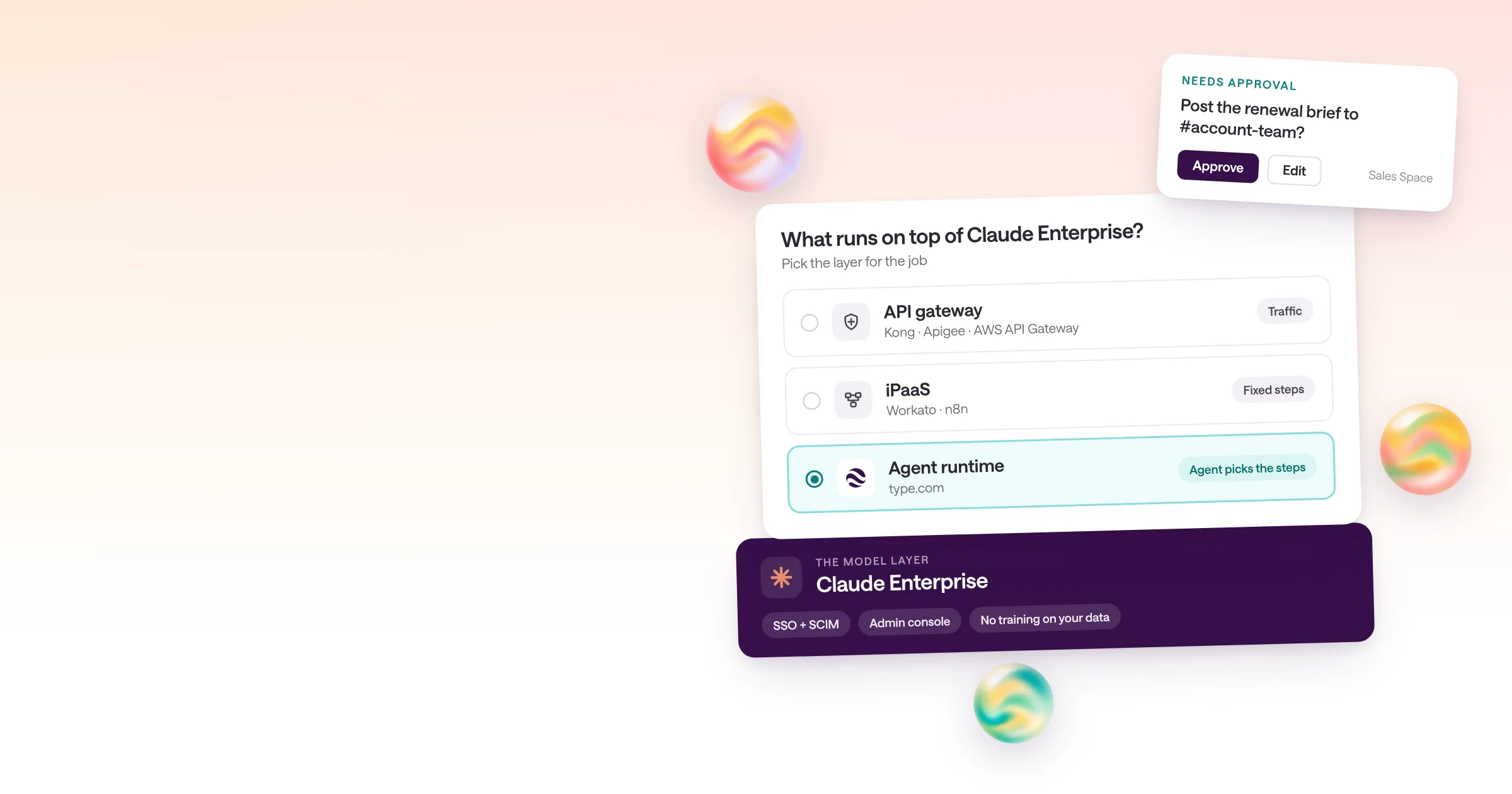
Companies that buy Claude Enterprise still need something on top of it to turn Claude into production workflows. The three approaches are an agent runtime, an iPaaS, and an API gateway, and each solves a different problem.
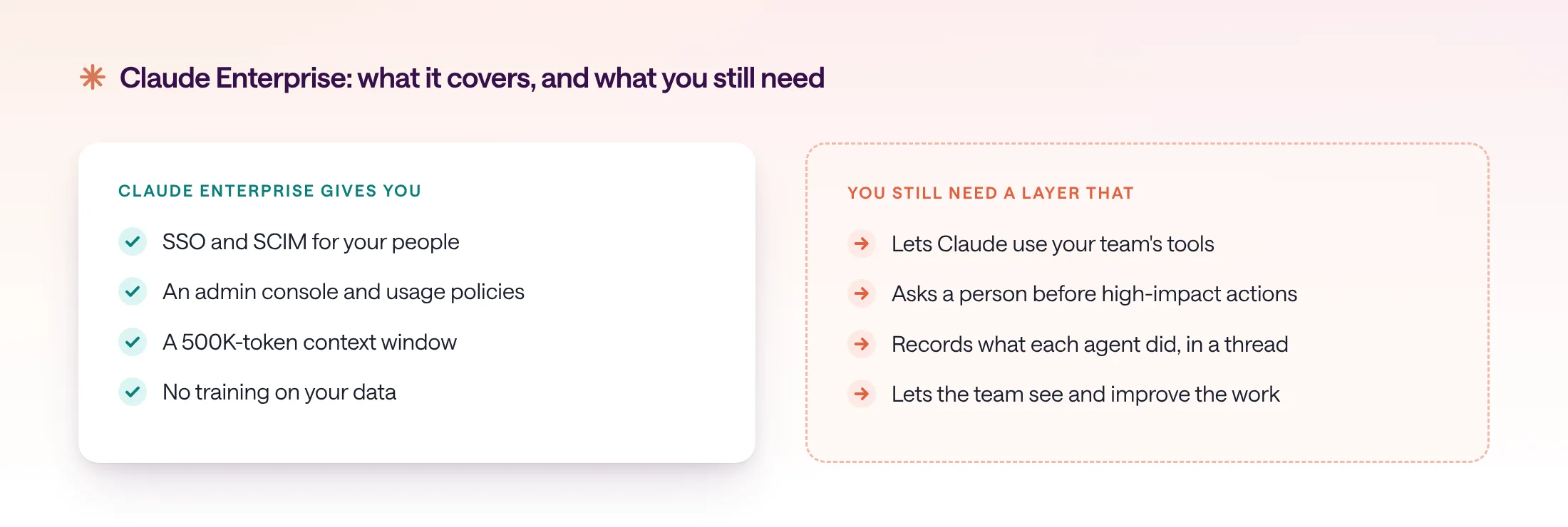
Claude Enterprise gives your organization a powerful model with SSO, SCIM provisioning, a 500K-context window, an admin console, and a commitment that Anthropic will not train on your data. What it does not give you is a way to deploy Claude as a production agent across your team's tools with governance, approval workflows, and a record of what each agent did.
That gap is where three categories of software compete: agent runtimes, iPaaS tools, and API gateways. Each frames itself as the answer, but they solve different problems. Picking the wrong one means either building agent infrastructure you should not own, or wiring together a workflow that breaks the moment the task requires judgment.
We make Type.com, which is an agent runtime, so read our take knowing that. We describe every approach using vendor documentation and pricing pages checked on October 29, 2026, and we say where each is the better choice.
What are the three approaches?
An agent runtime deploys Claude as an autonomous agent that plans its own steps, uses your company's tools, and operates inside governance controls. An iPaaS runs fixed, multi-step workflows with Claude as one node. An API gateway manages traffic to Claude's API without orchestrating any work.
The three approaches sit at different layers. An API gateway is infrastructure: it rate-limits, authenticates, and logs requests to Claude's API, but it does not make Claude do anything. An iPaaS is orchestration for fixed workflows: you draw a sequence of steps, and Claude is called at one or more of them. An agent runtime gives Claude a goal and tools, then lets it decide what to do, inside guardrails you set.
The confusion happens because all three connect to Claude's API. But connecting to an API and orchestrating autonomous work through it are different problems. A gateway manages connections. An iPaaS sequences them. A runtime delegates decisions to the model.
| Approach | What it does | Claude's role | Who builds it | Example |
|---|---|---|---|---|
| Agent runtime | Deploys Claude as an agent with tools, governance, and a readable record of every run | The decision-maker: plans steps, calls tools, adapts to input | The team that uses it | Type.com |
| iPaaS | Runs fixed multi-step workflows across apps | One step in a pipeline: summarize, classify, or extract | Operations or engineering | Workato, n8n |
| API gateway | Manages traffic to Claude's API: rate limits, auth, logging | A backend service behind the gateway | Platform engineering | Kong, Apigee, AWS API Gateway |
Where does Type.com fit? The agent runtime.
Type.com is an agent runtime: it deploys Claude and Codex agents to production with shared connections, human-in-the-loop approval, skills, run history, and Slack-native deployment, so the team that uses the agent also governs it.
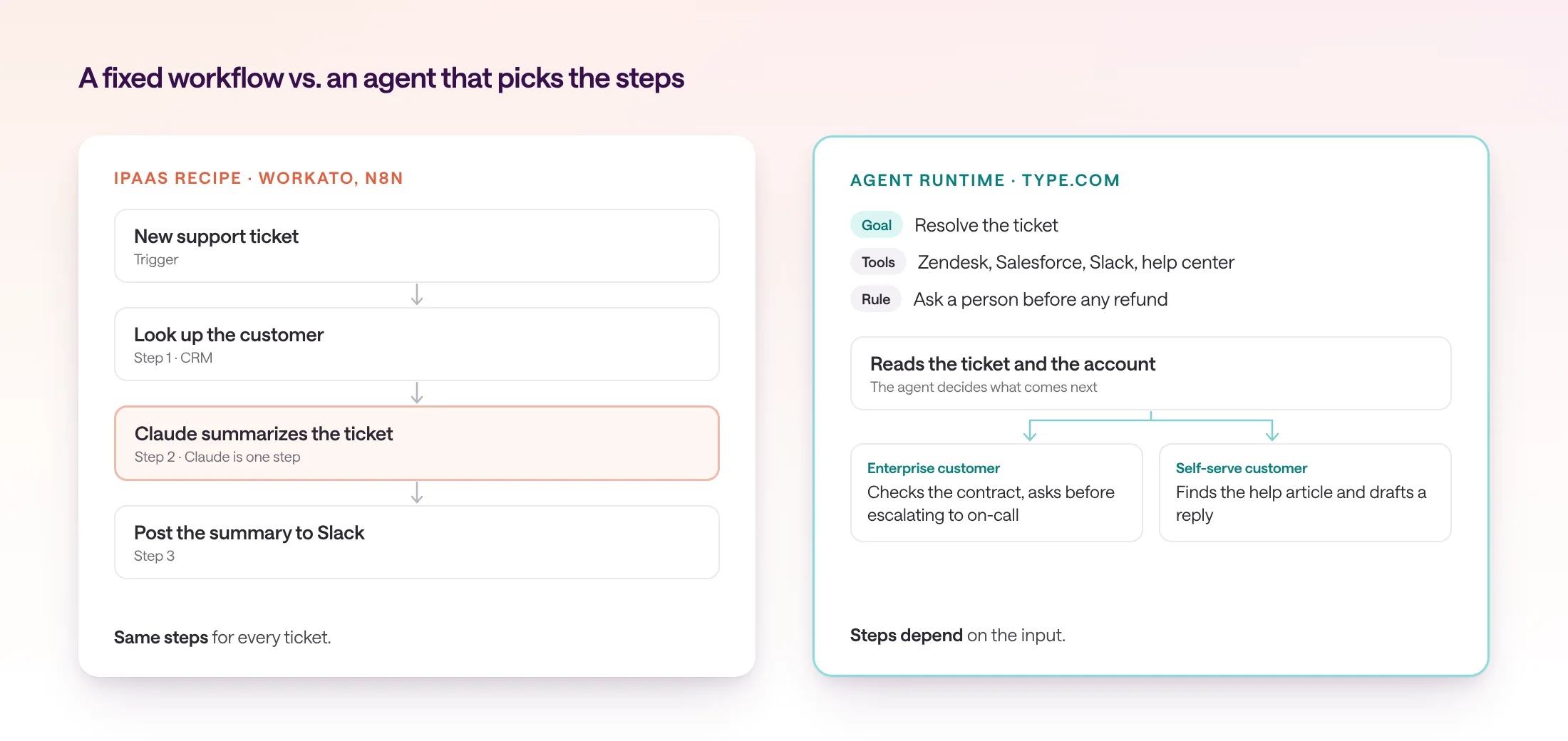
An agent runtime is different from both an iPaaS and a gateway because the model is in control of the workflow. You do not draw a sequence of steps. You give the agent a goal, the tools it can use, and the rules it must follow, and it figures out the steps. When it encounters something unexpected, it adapts. When it needs approval, it asks.
In Type.com, that looks like this: admins connect tools once per Space from nearly 1,000 native integrations plus custom APIs. They write rules as reusable skills the whole team can improve. Automations trigger from a schedule, Slack, GitHub, Linear, a webhook, email, or RSS, and each run leaves a thread the team can read, continue, and review.
Every tool call is visible in the thread. Automations run in isolated sandboxes. A schedule pauses after three consecutive failed runs. And team members can connect their own Claude subscriptions, so eligible requests run through them instead of the workspace's AI usage allowance.
The governance layer is what separates a runtime from just giving Claude API access. Without it, you get a smart model that can do things but no record of what it did, no approval before it acts, and no way for the rest of the team to see or improve the work.
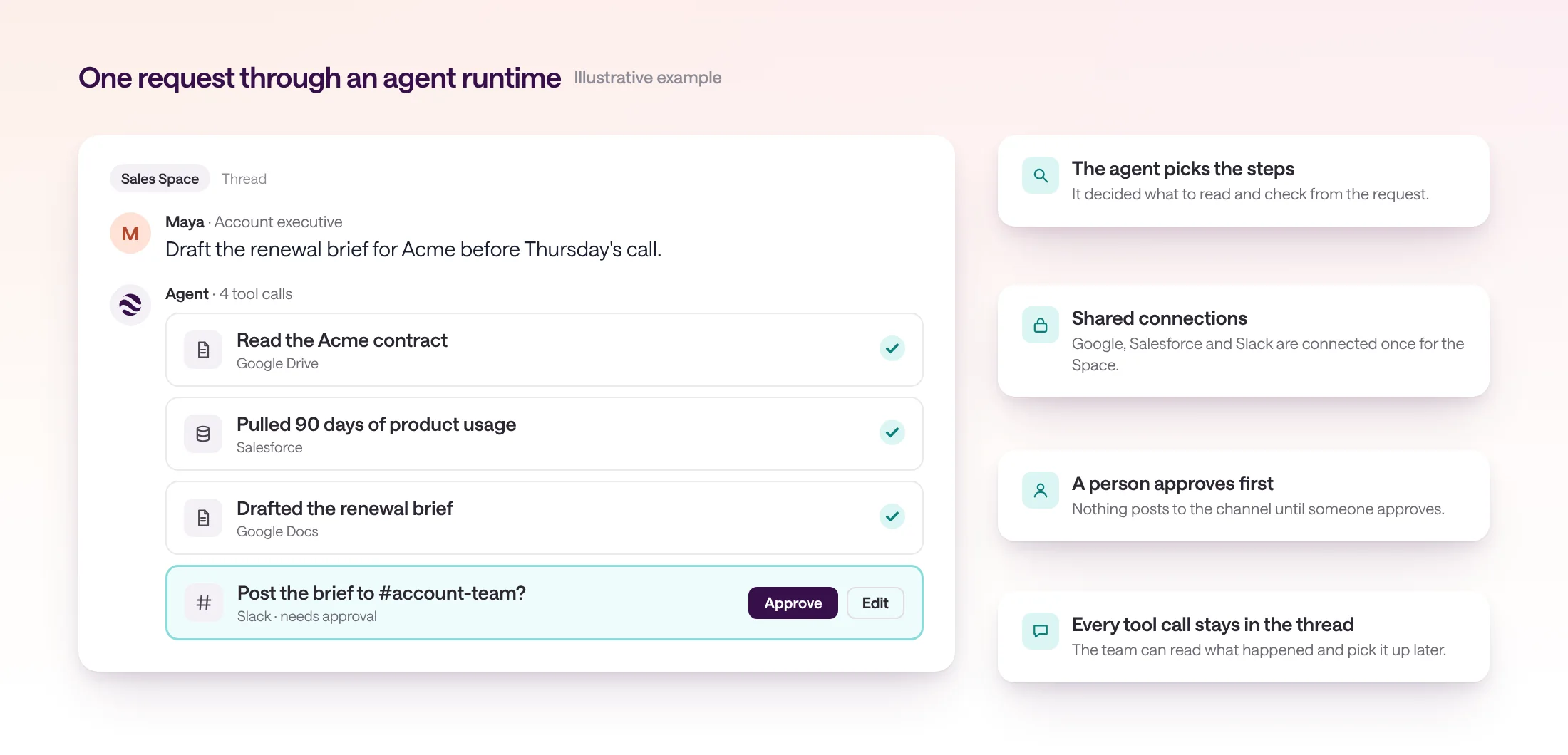
- The agent decides the steps, not a predefined workflow.
- Shared connections, skills, and threads across the team.
- Human-in-the-loop approval before high-impact actions.
- Every tool call visible in the run's thread.
- Slack-native: runs post results where the team already works.
- Connected Claude subscriptions can keep eligible spend on your existing plan.
What does an iPaaS give you?
An iPaaS like Workato or n8n runs fixed, multi-step workflows. Claude is called as one step: summarize this, classify that, extract these fields. The workflow is deterministic; the model is not making decisions about what to do next.
Workato is an enterprise automation platform with 1,200+ connectors and recipe-based workflows, priced through sales. Its Agentic Orchestration feature, added in 2026, lets you build multi-step LLM workflows, but the orchestration is still defined by the recipe author, not by the model. n8n is a workflow automation tool with 400+ integrations, a visual editor, and an AI Agent node for calling models inside a workflow. n8n Cloud starts at $20 a month billed annually, and its self-hosted Community edition is free under a Sustainable Use License.
Both tools are good at what they do. If the job is to sync new Salesforce contacts to HubSpot, reformat the data, and send a Slack notification, an iPaaS is the right choice. The steps are always the same. Claude adds value as a transformation step, not as a decision-maker.
Where iPaaS tools struggle is work that requires judgment. When a support ticket arrives and the right response depends on the customer's history, their contract tier, the content of the ticket, and whether it needs escalation, a fixed workflow cannot adapt. You end up building an increasingly complex decision tree that approximates what an agent does natively.
What does an API gateway give you?
An API gateway manages traffic to Claude's API: rate limits, authentication, request logging, and routing. It does not orchestrate work or give Claude tools. It is infrastructure, not a product layer.
API gateways like Kong, Apigee, and AWS API Gateway sit between your applications and Claude's API. They enforce rate limits so a runaway client cannot exhaust your token budget, centralize authentication so every team does not manage its own API keys, log every request for compliance, and route traffic across endpoints.
If your enterprise already has an API management policy, you probably need a gateway regardless of what else you run. But a gateway does not make Claude useful to a business team. It makes Claude's API manageable for platform engineers. The two are different problems.
How do the three approaches compare?
The table compares what you get from each approach across seven capabilities that matter to enterprises running Claude: agent autonomy, governance, approval workflows, activity records, team access, recurring work, and integration breadth.
The strongest version of extending Claude Enterprise uses more than one of these. A runtime handles agent work. An iPaaS handles deterministic plumbing. A gateway handles traffic policy. They are complementary, not competing, once you know which problem each solves.
| Capability | Agent runtime (Type.com) | iPaaS (Workato, n8n) | API gateway |
|---|---|---|---|
| Agent autonomy | Claude plans its own steps and adapts to input | Claude runs one fixed step in a predefined workflow | None: routes API calls, does not orchestrate |
| Governance | Space permissions, connection scoping, sandbox isolation | Recipe-level permissions, environment controls | Rate limits, API key management, request policies |
| Approval workflows | Human-in-the-loop: agent asks before high-impact actions | Manual approval steps in a workflow, but tied to the recipe | Not applicable |
| Activity record | Every tool call recorded in a thread the team can read; no exportable audit log yet | Execution logs per workflow run | Request and response logs |
| Team access | Shared Spaces with threads, skills, and connections | Shared recipes with role-based access | Developer portal for API consumers |
| Recurring work | Schedules, Slack triggers, webhooks, email, RSS, GitHub, Linear | Scheduled triggers, webhook triggers, app event triggers | Not applicable: the gateway does not start work |
| Integration breadth | ~1,000 native integrations plus custom APIs and MCP | Workato: 1,200+ connectors; n8n: 400+ integrations | Routes to any HTTP endpoint; no app-level connectors |
Why enterprises with Claude Enterprise need a runtime
Enterprises using Claude Enterprise specifically need a runtime, not just an iPaaS, because the value of Claude is in its judgment, and an iPaaS reduces it to a text transformation step.
Claude Enterprise is expensive. Organizations buy it because they need a model that can reason about complex work with long context and strong capabilities, inside an environment with enterprise security controls. Using that model only as a step in a fixed pipeline is like hiring a senior analyst and giving them a script to read.
A runtime lets Claude do what it is good at: read a long document, decide what matters, check it against company data, draft a response, and ask a human before sending it. The iPaaS path forces you to anticipate every possible document, every edge case, and every decision point in advance. For simple transformations, that works. For the work enterprises actually bought Claude to do, it does not.
The governance question matters too. Claude Enterprise gives you admin controls at the model access level: who can use Claude, what data it sees, and whether it trains on your inputs. But it does not give you governance at the agent level: what Claude can do with your tools, who approves its actions, and where the record of what it did lives. A runtime adds that layer. An iPaaS governs the workflow, not the model's decisions within it.
When does each approach make sense?
Use a runtime for agent work where Claude decides the steps. Use an iPaaS for deterministic workflows where the steps are always the same. Use a gateway when your API management policy requires one. Most enterprises use at least two.
The honest answer is that these are not substitutes for each other. They solve different problems, and most enterprises running Claude Enterprise at scale will use more than one.
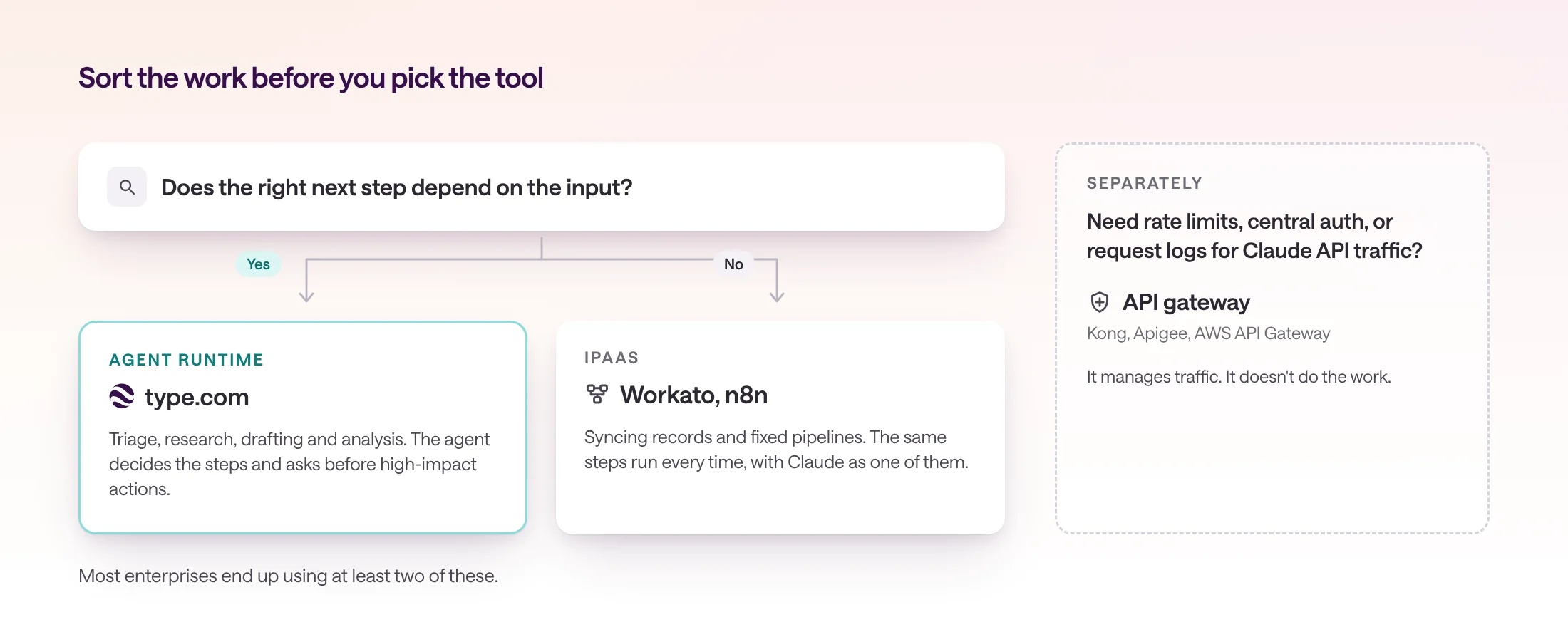
- Use a runtime (like Type.com) when: the work requires judgment, the right steps depend on the input, multiple tools are involved, the team needs to see what the agent did, and actions need approval before they happen.
- Use an iPaaS (like Workato or n8n) when: the workflow is fixed and repeatable, Claude is doing summarization, classification, or extraction as one step, and the value is in connecting many apps reliably.
- Use an API gateway when: you need rate limiting, centralized auth, or request logging for Claude API traffic, and your security or platform team requires it by policy.
- Use a runtime and an iPaaS together when: you have both agent work and deterministic plumbing, which most enterprises do.
How should you choose?
Start by listing the work you want Claude to do, then sort it: work that requires judgment goes to the runtime, work with fixed steps goes to the iPaaS, and traffic policy goes to the gateway.
Do not start with a tool and look for problems it solves. Start with the work. Write down the ten things you want Claude to do across your organization. For each one, ask: does the right approach depend on the input, or is it always the same steps? The first kind is agent work. The second kind is workflow automation.
For a broader comparison of agent platforms, see the best AI agent platforms for teams. For the build-vs-buy decision, see build vs buy AI agents. And for a detailed look at how Type.com compares with n8n and Zapier, see our guides to n8n alternative for AI automations and Zapier alternative for AI automations.
Frequently asked questions
What platforms do companies use on top of Claude Enterprise?
Three kinds: agent runtimes like Type.com that deploy agents to production with governance and human-in-the-loop approval, iPaaS tools like Workato and n8n that wire Claude into multi-app workflows, and API gateways like Kong that manage traffic to Claude's API. Most enterprises with Claude Enterprise need at least two: a runtime for agent work and either an iPaaS or a gateway for integration and traffic management.
What is the difference between an agent runtime and an iPaaS for Claude Enterprise?
An agent runtime gives Claude autonomy inside guardrails: it plans its own steps, uses tools, asks for approval when needed, and records every action in a thread the team can read. An iPaaS runs a fixed workflow you define in advance, calling Claude as one step among many. The runtime is for work where the right steps depend on the input. The iPaaS is for work where the steps are always the same.
Is Type.com an iPaaS?
No. Type.com is an agent runtime. An iPaaS executes a workflow you draw: step one, step two, step three, always in order. Type.com gives a Claude or Codex agent a goal, tools, and rules, then lets it decide which tools to call and in what order, inside a governed sandbox with shared connections, and records every tool call in the run's thread. The agent can adapt to unexpected input; a workflow cannot.
Do I still need Workato or n8n if I use Type.com?
Often yes, for different work. Use Type.com for agent work: research, triage, drafting, analysis, and any job where the right steps depend on the input. Use an iPaaS for deterministic plumbing: syncing records between systems, transforming data on a schedule, or routing events through a fixed pipeline. Some teams consolidate simpler iPaaS workflows into Type.com automations over time, but there is no reason to force it.
Why would an enterprise use an API gateway with Claude Enterprise?
An API gateway like Kong or Apigee sits in front of Claude's API to enforce rate limits, centralize authentication, log every request, and route traffic across multiple model endpoints. It does not make Claude do useful work; it governs the traffic. Enterprises with existing API management policies often require one regardless of what else they run.
Can Type.com use my company's Claude Enterprise plan?
Each team member can connect their own Claude subscription to Type.com. Eligible requests then run through that subscription instead of drawing from the workspace's AI usage allowance, so if your people's Claude Enterprise seats connect this way, that spend stays on your existing agreement. Requests that aren't eligible bill against the workspace allowance, and admins can see which runs used a personal subscription in Settings → Cost.