Skills Library
Best StartupCookie AI skills for content teams
Seven skills from a working content agency that make AI drafts sound human, keep facts straight, and package work for client review.
By type.com Team
What are the best StartupCookie AI skills?
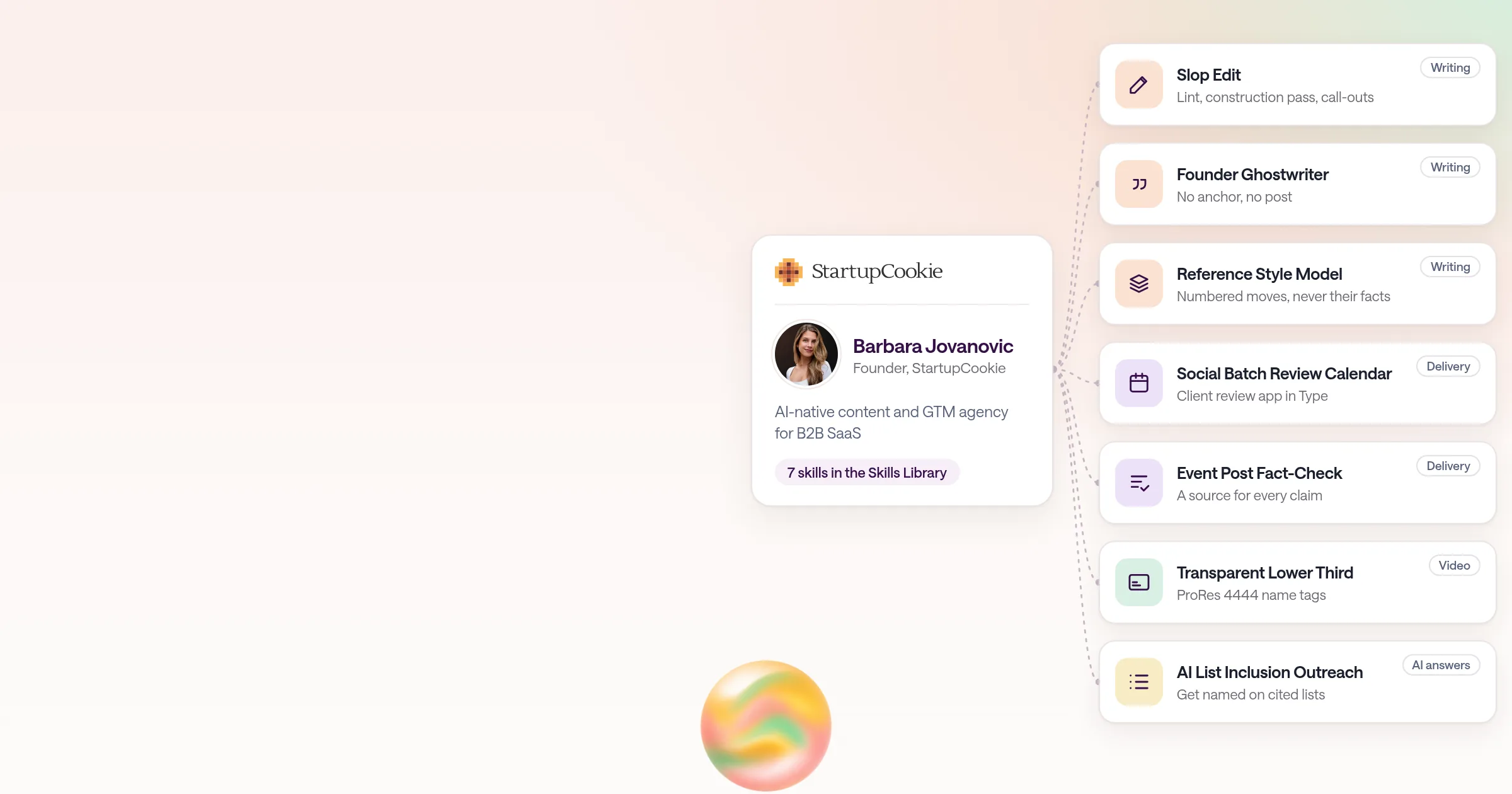
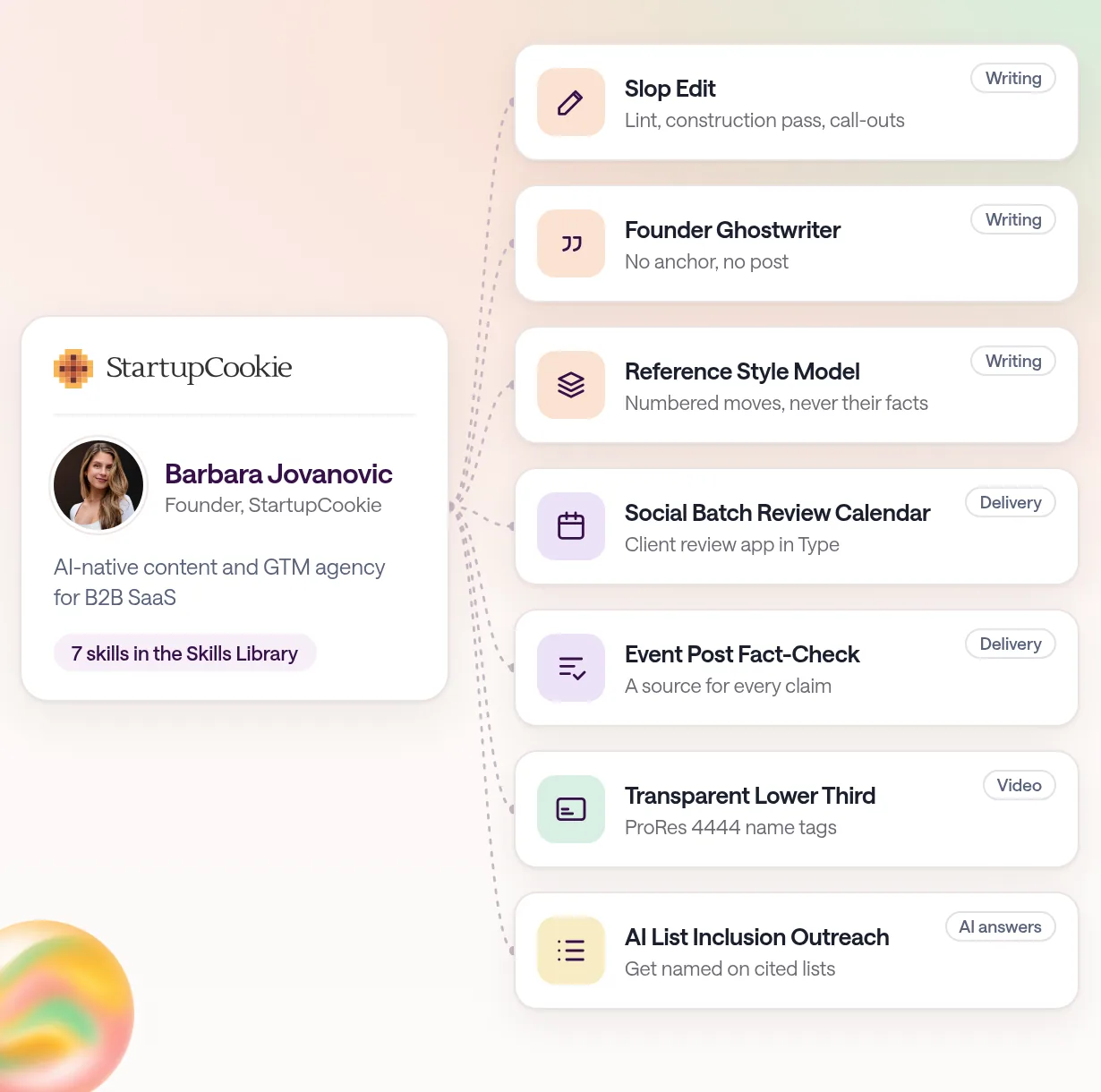
The best StartupCookie AI skills are Slop Edit, Founder Ghostwriter, Reference Style Model, Social Batch Review Calendar, Event Post Fact-Check, Transparent Lower Third, and AI List Inclusion Outreach. Together they cover how a content team writes, checks, delivers, and distributes client work.
Most AI content problems happen after the first draft. The post sounds like a model wrote it, quotes something the founder never said, names a sponsor that was not one, or sits in a PDF the client cannot copy from. These seven skills each handle one of those problems.
Barbara Jovanovic, founder of StartupCookie, built them from the agency's client work in type.com. Client names are removed, and the examples use fictional companies.
Browse them in the type.com Skills Library, or read how StartupCookie runs its agency on type.com.
| Skill | Best for | What you get |
|---|---|---|
| Slop Edit | Anyone shipping posts, emails, or page copy that an AI helped write | A lint report, a line-edited draft, and a new rule for every correction a reviewer makes |
| Founder Ghostwriter | Agencies and in-house teams writing LinkedIn and X posts for a named founder | A batch of posts, each with its verbatim anchor, a claims check, reader scores, and open items |
| Reference Style Model | Brand pages told "we want our LinkedIn to sound like them" | A style spec of numbered moves, a gap analysis, and a yes/no pre-publish checklist |
| Social Batch Review Calendar | Agencies sending a batch of three or more social posts for client approval | A Type app with a weekly calendar and list view, copyable captions, and full-resolution downloads |
| Event Post Fact-Check | Speakers, attendees, and company pages posting after a conference or summit | A complete draft, a claims table with a source for every fact, and questions for the author |
| Transparent Lower Third | Teams producing testimonial or interview videos | Animated name tags as transparent ProRes 4444 .mov files, checked frame by frame |
| AI List Inclusion Outreach | B2B marketers working on how their company shows up in AI answers | A ranked list of cited roundups, a three-line request for each, and a send and follow-up tracker |
Which StartupCookie skills should a content team use?
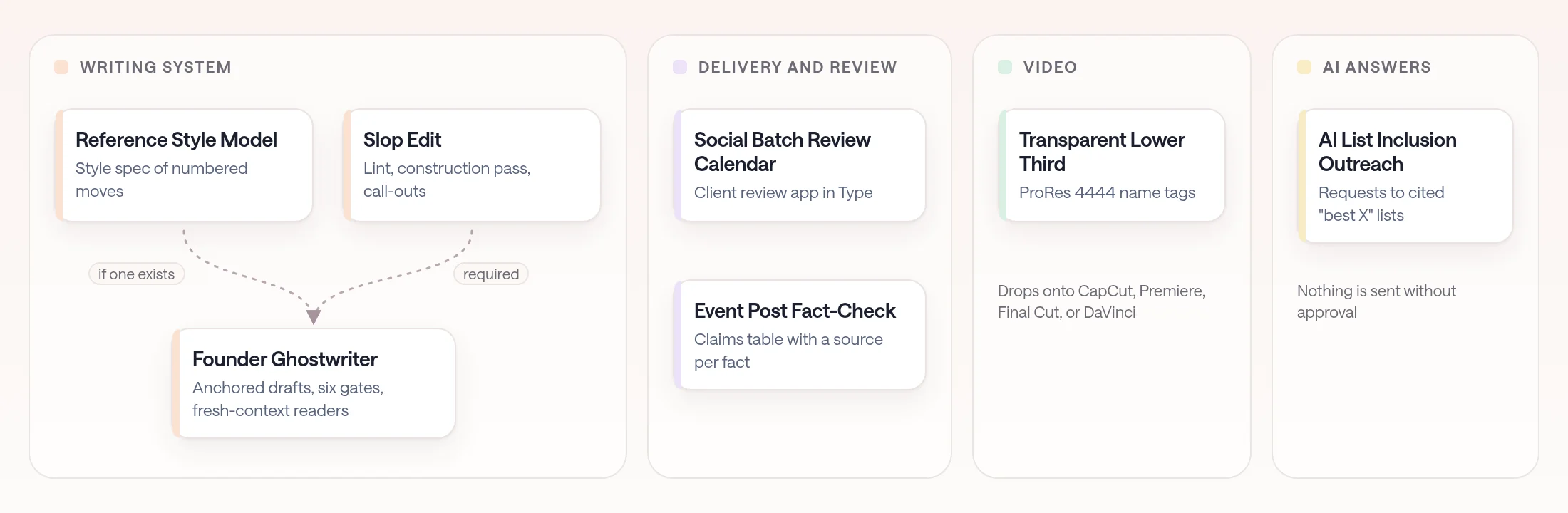
The seven skills fall into four groups: a writing system, client delivery and review, video, and getting named in AI answers.
Slop Edit, Founder Ghostwriter, and Reference Style Model form the writing system: Founder Ghostwriter requires Slop Edit and loads a Reference Style Model when one exists. Social Batch Review Calendar and Event Post Fact-Check handle delivery and accuracy. Transparent Lower Third and AI List Inclusion Outreach each stand alone.
1. Slop Edit
Slop Edit line-edits a draft so it stops reading as AI-written, with a mechanical lint for surface patterns, a sentence-by-sentence construction pass, and a call-outs file that turns every reviewer correction into a rule.
A ban list alone never converges, because the model reaches for the nearest sibling phrase. The bundled scripts/slop_lint.py catches 40+ patterns, from em dashes and mirror constructions to engagement-bait closers and hashtag overload. The hand pass then checks who does each verb and what each sentence literally says. It needs only Python 3 and its standard library.
- Best for
- Anyone shipping posts, emails, or page copy that an AI helped write
- Works from
- Any draft, plus the call-outs file of past reviewer corrections if you have one
- You get
- A lint report, a line-edited draft, and a new rule for every correction a reviewer makes
2. Founder Ghostwriter
Founder Ghostwriter writes LinkedIn and X posts in a founder's voice, grounded only in things they actually said, and runs every draft through six gates and fresh-context readers before you see it.
Its rule is "No anchor, no post": every opinion traces to a dated quote from the person, so nothing is put in their mouth. A per-person reference set holds the voice corpus, an anchor bank, a feedback ledger, and rewrite pairs, and gets sharper with every edit. Cold, hostile-expert, and persona readers run in a clean context and catch lines that do not sound like the person.
- Best for
- Agencies and in-house teams writing LinkedIn and X posts for a named founder
- Works from
- Call transcripts or notes, plus the person's existing posts. Requires Slop Edit
- You get
- A batch of posts, each with its verbatim anchor, a claims check, reader scores, and open items
3. Reference Style Model
Reference Style Model turns a reference company's public posts into a style spec of numbered moves, each proved by a real line, with a gap analysis and a pre-publish checklist.
A vague brief becomes 8 to 12 moves that every draft can be checked against. The gap analysis shows what you already do and what is new, which is usually a small shift. The moves transfer and the evidence does not: the reference company's numbers, customers, and claims never appear in your drafts, and your existing bans stay in place.
- Best for
- Brand pages told "we want our LinkedIn to sound like them"
- Works from
- Public posts from the reference company, plus 3 to 10 of your own posts
- You get
- A style spec of numbered moves, a gap analysis, and a yes/no pre-publish checklist
4. Social Batch Review Calendar
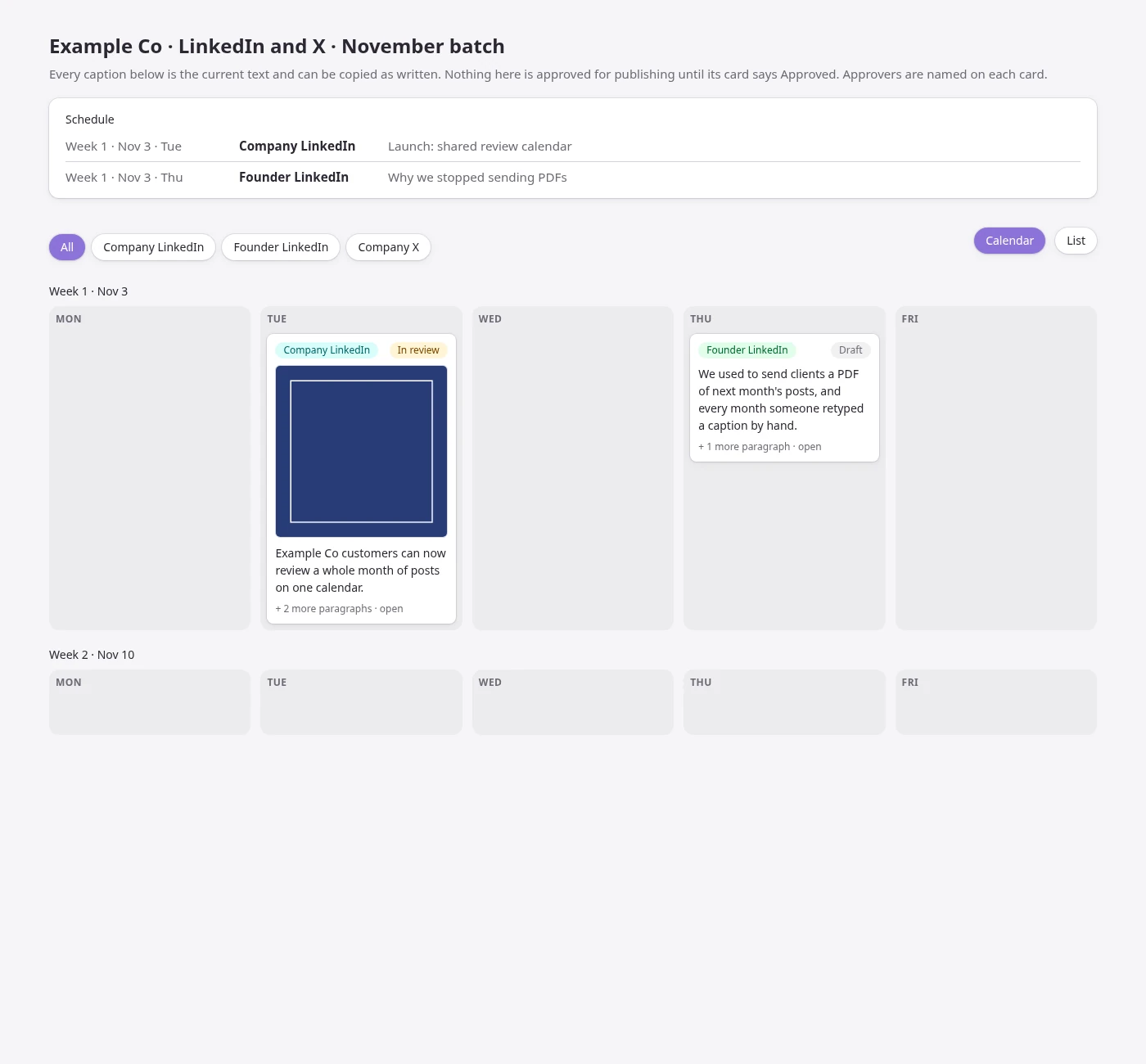
Social Batch Review Calendar builds a Type app your client can review a social batch in: a weekly calendar and list view, copyable captions, downloadable full-resolution visuals, and the approver and status on every card.
PDFs, Word docs, and chat recaps each fail one part of review: reading the caption, seeing the visual, copying the text, or knowing who approves. The skill ships a React and Vite template that has been used with real clients, plus encode_visuals.py, which uses Pillow to pack the images into the app.
- Best for
- Agencies sending a batch of three or more social posts for client approval
- Works from
- A settled batch of captions and visuals, with an approver for each post
- You get
- A Type app with a weekly calendar and list view, copyable captions, and full-resolution downloads
5. Event Post Fact-Check
Event Post Fact-Check drafts post-event posts and labels every fact in a claims table as Program, Program description, Recollection, Verified, or Unverified, so what the official program proves stays separate from what someone remembers.
Event posts go wrong in predictable ways: a sponsor that was not one, an outdated affiliation, a photo paired with the wrong talk, an "official" hashtag nobody uses. The skill checks speakers, affiliations, sessions, sponsorships, photos, and hashtags against the program, removes what it cannot verify, and still delivers a full draft instead of placeholders.
- Best for
- Speakers, attendees, and company pages posting after a conference or summit
- Works from
- What the person remembers, plus web access to the event's program or agenda
- You get
- A complete draft, a claims table with a source for every fact, and questions for the author
6. Transparent Lower Third
Transparent Lower Third makes on-brand animated name tags for testimonial videos as transparent ProRes 4444 .mov files that drop straight onto a CapCut, Premiere, Final Cut, or DaVinci timeline.
It pulls brand fonts and colors from your live site and renders supersampled motion, which fixes the usual choppy animation. Geometry is locked across a series, so every tag matches except the name and role. verify_overlay.py checks transparency, placement, and smoothness. It needs Python with Pillow and numpy, plus ffmpeg.
- Best for
- Teams producing testimonial or interview videos
- Works from
- Each person's name and role, your website URL, and your brand font files
- You get
- Animated name tags as transparent ProRes 4444 .mov files, checked frame by frame
7. AI List Inclusion Outreach
AI List Inclusion Outreach gets you named on the "best X" lists that ChatGPT, Claude, Perplexity, and Google AI answers already cite for your buyers' questions. It ranks the lists, drafts a three-line request for each, and tracks sends and follow-ups.
It starts from the pages AI answers actually cite, not a generic list of directories, and routes each request to the right channel. Nothing is sent without approval, and only from the owner's own accounts. Expect a low reply rate: in the campaign the skill came from, 1 of 7 sent requests got a reply.
- Best for
- B2B marketers working on how their company shows up in AI answers
- Works from
- Citation data from an AEO tracker or manual logged-out prompt checks, plus the owner's email or LinkedIn
- You get
- A ranked list of cited roundups, a three-line request for each, and a send and follow-up tracker
How do the StartupCookie writing skills work together?
Founder Ghostwriter writes from the founder's own words, Reference Style Model sets the shape for a brand page, and Slop Edit cleans every draft before anyone reads it.
Ghostwriting with AI usually fails in one of two ways. The post sounds generic, or it says something the founder never said. Founder Ghostwriter handles the second problem with one rule, "No anchor, no post." If an idea cannot be traced to a dated quote from the person, the skill drops the post or asks one question to get an anchor.
Each draft then passes six gates: accuracy, slop lint, sameness against the rest of the batch, voice, a humanizer check against the person's measured baselines, and a sentence-subject check. Reviewers in a clean context read the final text without seeing the anchors, so they cannot forgive a line because they know what it meant to say.
Every correction feeds back in. When the founder rewrites a line, the pair goes into the reference set. When a reviewer flags a pattern, Slop Edit logs it in the call-outs file, and a pattern flagged twice becomes a lint rule.
Example request
Here are the transcripts from my last two calls with Dana and her last 20 LinkedIn posts. Draft this week's batch of three posts for her personal LinkedIn.
- Slop Edit: 40+ lint patterns, a construction pass, and a call-outs file.
- Founder Ghostwriter: a verbatim anchor for every opinion, six gates, and fresh-context readers.
- Reference Style Model: numbered moves from a reference account, never its facts or numbers.
How do agencies get client sign-off on content?
Social Batch Review Calendar puts a batch in a Type app where the client can read, copy, download, and see who approves each post.
Agencies often send a batch as a PDF or a long chat message. The client cannot copy a caption cleanly, the image is cropped, and nobody is sure who signs off. The calendar app follows three rules: the caption is real, copyable text, the visual sits uncropped under its caption, and every card names the approver and the status.
Event Post Fact-Check covers the accuracy side for event posts. Its claims table separates what the official program proves from what the author remembers, and it removes a claim it cannot verify, such as a sponsorship that appears only on a flyer photo.
- Program: stated in the official event materials.
- Program description: what a talk was meant to cover, written before the event.
- Recollection: what the author remembers, used in the first person only.
- Verified: confirmed on the person's or company's own site.
- Unverified: not usable until confirmed, so it is removed or asked about.
How do you add name tags to testimonial videos?
Transparent Lower Third renders name tags as transparent ProRes 4444 files, so editors drop them on the timeline over the video.
Testimonial videos need a name tag for every speaker, and they should match across the series. The skill pulls the brand from your live website, locks the geometry so only the name and role change, and renders the motion supersampled so it does not stutter.

- 1
Send names and brand
Give the skill each person's name and role, your website URL, and your brand font files.
- 2
Render and verify
The skill renders one .mov per person and runs verify_overlay.py to check transparency, placement, and smoothness.
- 3
Drop it on the timeline
Put the .mov file on the timeline above the video, not the preview MP4, which has a background baked in.
How do you get named on the lists AI answers cite?
AI List Inclusion Outreach finds the roundups that AI answers already cite for your buyers' questions and drafts a short request to be added to each.
When a buyer asks ChatGPT or Perplexity for the best tool in a category, the answer often leans on third-party "best X" lists. Getting named on those pages is one of the faster off-site levers. The skill ranks the cited lists, skips lists where the publisher ranks only its own product, and drafts a three-line request: who you are, one proof point, and one ask.
Keep expectations realistic. In the campaign this skill came from, 1 of 7 sent requests got a reply. The value is in picking the right lists and keeping every message short.
How do content teams run StartupCookie skills in type.com?
In type.com, an agency installs the skills into a shared Space and gives each client its own Space, so every writer uses the same rules and every correction reaches the whole team.
Install the skills from the library, and the call-outs file, the founder's reference set, and the style model live where the whole team can reach them. When one writer logs a correction, the next draft for that client follows it.
See how StartupCookie works in type.com, or browse every skill in the type.com Skills Library.
Frequently asked questions
Who made these skills?
Barbara Jovanovic, founder of StartupCookie, made them. She distilled them from StartupCookie's real client work in type.com in September and October 2026 and removed every client name. The examples use fictional companies and people, such as Example Co, Fieldnote, and Dana Lee. Each type.com listing credits StartupCookie.
What is StartupCookie?
StartupCookie is an AI-native content and GTM agency for B2B SaaS. It runs product marketing, founder LinkedIn ghostwriting, thought leadership, AI-search content, and video for its clients.
Which skill should I start with?
Start with Slop Edit. Founder Ghostwriter requires it, and AI List Inclusion Outreach and Event Post Fact-Check use it when it is installed. Then add the skill for the work you already do every week.
What do these skills need to run?
Slop Edit needs Python 3 and nothing else. Founder Ghostwriter needs Slop Edit. Social Batch Review Calendar needs a Type app and Python 3 with Pillow. Transparent Lower Third needs Python 3 with Pillow and numpy, ffmpeg, and your brand font files. The other skills need web access.
Will these skills post or send anything on their own?
No. Founder Ghostwriter and Event Post Fact-Check deliver drafts with open questions for the person who approves them. AI List Inclusion Outreach drafts every request and sends nothing without approval, and only from the owner's own accounts.
Do these skills work outside type.com?
Most do. The skills are SKILL.md folders, so they run in Claude Code, Codex, and other agents that read SKILL.md. Social Batch Review Calendar builds a Type app, so it is made for type.com.