


Who does the AI work
type.com
Everyone, in the same threads. Builders and everyday users see each tool call and pick up each other's work.
HQ
Mostly a smaller operator group. Everyone else uses their workflows through chat apps and bots.
HQ gives your strongest AI users a company brain to build inside their own AI tools. type.com puts your whole team in one hosted workspace, where the people who build AI workflows and the people who use them work in the same threads.
14-day free trial. Runs on Claude and Codex.
HQ calls itself the company brain that AI runs on: company knowledge, skills, and workflows kept as plain files that Claude Code, Codex, and Cursor open directly, and that chat tools reach over MCP. HQ's FAQ says a smaller operator group usually installs it and builds the skills for everyone else.
type.com is one hosted workspace your whole team signs into from a browser, the desktop app, or Slack, with nothing to install. Builders and everyday users work in the same threads and see each tool call the agent makes. For a 10-person team, type.com Enterprise is $250 a month and HQ Workforce is $500 a month.
What decides it
Both products help a team share what its best AI users figure out. These are the choices underneath.
Everyone, in the same threads. Builders and everyday users see each tool call and pick up each other's work.
Mostly a smaller operator group. Everyone else uses their workflows through chat apps and bots.
Nothing. type.com is hosted, so people work from a browser, the desktop app, Slack, or email.
Local files opened in an AI coding tool, with Git as a technical dependency and a sync app.
In Spaces. Skills, connections, memory, and automations are shared by Space.
In plain files your company owns, portable across Claude Code, Codex, Cursor, and chat tools.
Who builds
HQ is built around a few strong operators. Its FAQ says a smaller group usually installs HQ, builds Skills, manages Integrations, and governs access, while everyone else uses those workflows through Claude Desktop, the ChatGPT app, or bots in Slack and email. Builders work where they're fastest, and the rest of the team sees finished workflows.
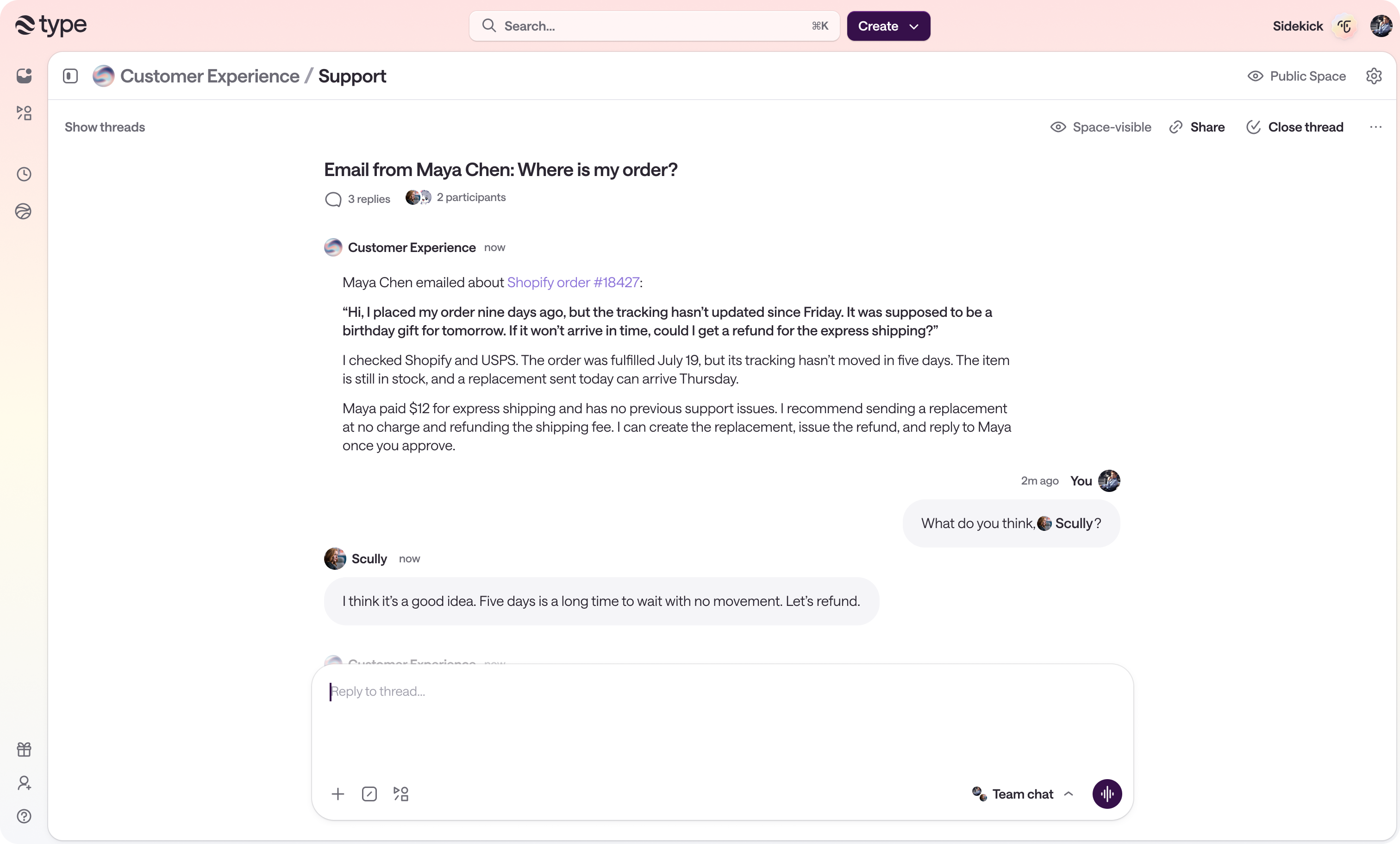
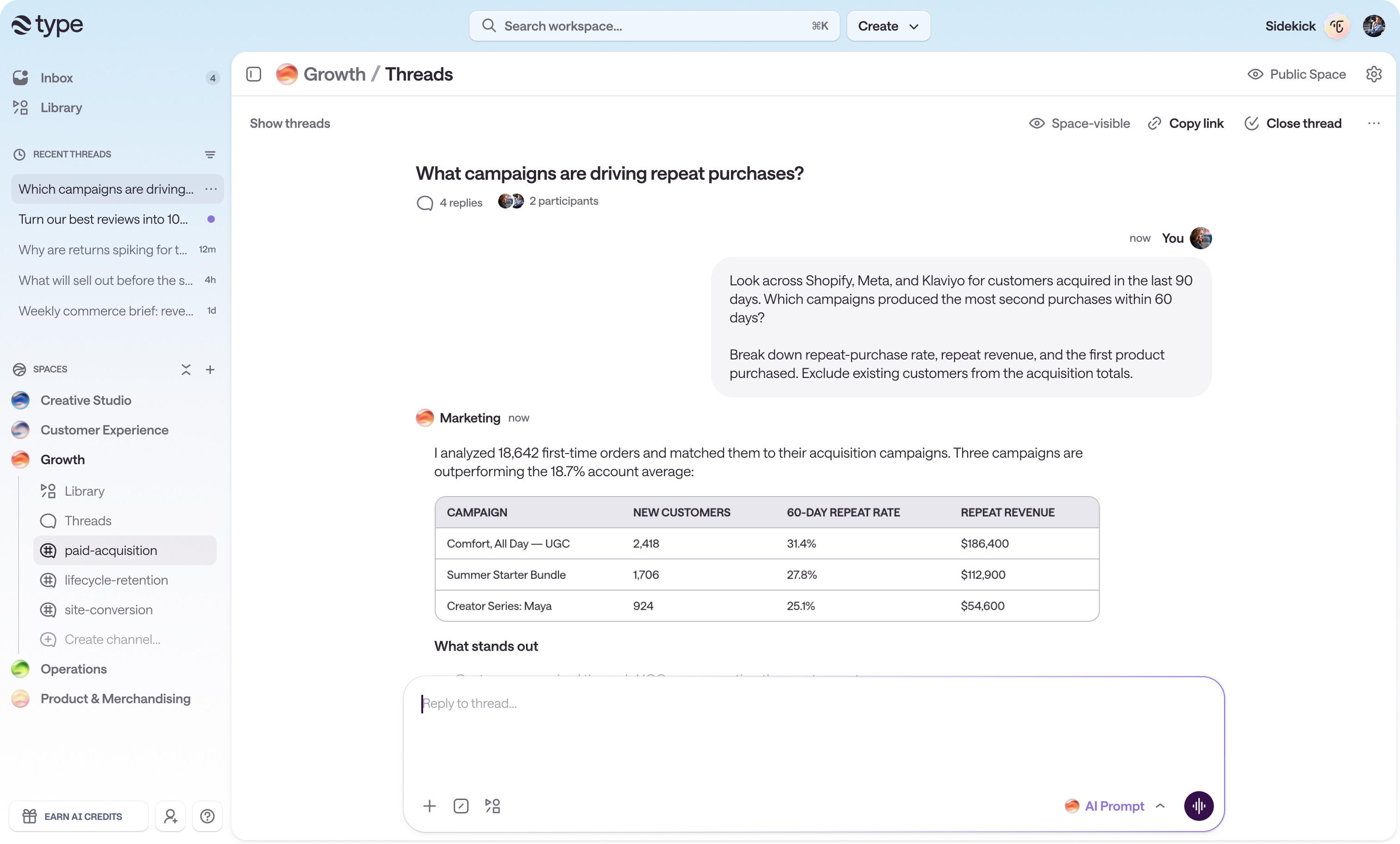
type.com puts both groups in one place. Builders keep Claude and Codex, which run as the agent in every Space, and can push a live Claude Code or Codex session into a thread from the CLI. Each department gets a Space, and its threads are visible to everyone in it unless made private, so the person who wrote a skill and the person running it for the first time read the same thread.
Raycon runs a Space for each team, from Marketing and CX to Supply Chain and Operations. As co-founder and CEO Ray Lee put it, “Now you're not relying on just your AI power users.”
Setup
HQ is local-first. The full workspace is ordinary files opened in a supported AI coding tool, Git is a technical dependency, and HQ Cloud syncs copies between machines. HQ's security overview notes that each person's computer is part of the trust boundary, so securing those machines and the credentials on them stays with your team.
type.com is hosted. Your team works from a browser, the desktop app, Slack, or email, and there is no local workspace, Git setup, or sync app to keep running on each machine.
Cost
type.com Pro covers up to 4 team members, so a 10-person team is on type.com Enterprise: $250 a month for up to 20 team members and 500 AI usage credits. Every plan has the same features. Team members can also connect their own Claude or Codex subscriptions, and eligible requests run through them instead of the workspace's credits.
HQ's free Starter plan stops at 5 people, so a 10-person team is on Workforce: $500 a month for unlimited people, with hosted bots from $100 a month per box. HQ's local agent work runs on each person's own model-provider account. Because Workforce is a flat price, HQ costs less than type.com's self-serve plans once a team passes 40 people.
Full comparison
Grouped by the decisions a small team makes when it picks a shared AI workspace.
Anyone in the Space. Builders and everyday users work in the same threads.
Usually a smaller operator group.
Threads and each tool call are visible to everyone in the Space, unless a thread is made private.
Each person works in their own AI tool, and HQ syncs the files and outputs.
The browser, the desktop app, Slack, and each Space's own email address.
Claude Code, Codex, and Cursor, ChatGPT and Claude over MCP, and bots in Slack, email, and Telegram.
Nothing. The desktop app is optional.
The HQ workspace, opened in an AI coding tool, with Git. Chat-only teammates can connect over MCP.
One hosted copy of every thread, skill, and connection.
A sync app that keeps local and cloud copies aligned and surfaces merge conflicts for review.
Each skill has an owner. Others suggest changes for the owner or an admin to accept, and version history supports restore.
Shared company files that can be reviewed, tested, and rolled back.
Personal or organization connections, each assigned to the Spaces that need it.
Connected once in an encrypted vault and granted to people, groups, or bots.
Automations that start from schedules, webhooks, app events, Slack, email, or RSS.
Bots that run on a schedule or company event, and Workers that define reusable jobs.
Claude and Codex are the agents in every Space, on your own subscriptions or included credits. The CLI pushes a live Claude Code or Codex session into a thread.
Claude Code, Codex, and Cursor open HQ on each builder's machine, and chat tools connect over MCP.
Mention it in Slack, email a Space's address, or let automations start it on a schedule or event.
Fleet Agents with their own identity and cloud runtime, reachable in Slack, email, and Telegram.
$250 a month on type.com Enterprise, for up to 20 team members and 500 AI usage credits a month.
$500 a month on Workforce, plus hosted bots from $100 a month per box.
Self-serve plans up to 60 team members at $750 a month, with custom contracts beyond that.
$500 a month at any headcount.
HQ has real strengths, and some teams should pick it. It is probably the better fit if:
FAQ
Yes, for teams that want everyone working in one place. HQ is a company context layer that a smaller group of operators usually builds inside Claude Code, Codex, or Cursor. type.com is one hosted workspace where the people who build AI workflows and the people who use them work in the same threads.
Not for type.com. It is hosted, so people work from a browser, the desktop app, Slack, or email. HQ's full workspace is local files opened in an AI coding tool, with Git as a technical dependency and a sync app. Teammates who only use chat can reach HQ over MCP.
Yes. Claude and Codex are the agents in every type.com Space, and team members can connect their own Claude or Codex subscriptions. Builders can push a live Claude Code or Codex session into a type.com thread from the CLI, so the rest of the team sees the work and can continue it.
Both products plan for them. In HQ, a smaller operator group builds the workflows and everyone else uses them through Claude Desktop, the ChatGPT app, or bots. In type.com, everyday users work in the same threads as the builders, from the browser, Slack, or email, and can pick up where a coworker left off.
A 10-person team pays $250 a month on type.com Enterprise, which covers up to 20 team members and 500 AI usage credits. HQ's Starter plan stops at 5 people, so 10 people need Workforce at $500 a month, plus hosted bots from $100 a month per box. HQ costs less than type.com once a team passes 40 people.
When you want company knowledge in plain files on an open-source core, or when your team is larger than 40 people, where HQ's flat $500 a month costs less than type.com's self-serve plans.
type.com runs Claude and Codex in hosted Spaces your whole team shares, reachable from Slack and email, with nothing to install on anyone's laptop.
Get started for free14-day free trial. Plans for 2 to 60 team members. Bring your own Claude or Codex subscription.